
An Employer Identification Number (EIN) is a nine-digit federal tax ID the IRS assigns to a business for tax filing and reporting purposes, formatted as XX-XXXXXXX. The IRS issues EINs at no cost, and if you apply through the IRS online EIN Assistant, your number is issued immediately upon verification.
You likely need an EIN right now if any of these apply to your business:
- You have hired or plan to hire employees
- Your business is structured as a corporation, partnership, or multi-member LLC
- You need to open a business bank account
- You are filing employment taxes or certain excise taxes
- You are a nonprofit, trust, or estate with tax obligations
Key Takeaways
An EIN is a permanent, free, nine-digit federal tax ID issued by the IRS that every employer, corporation, partnership, and multi-member LLC in the United States must obtain before running payroll or filing business tax returns.
| Point | Details |
|---|---|
| EIN definition and format | A nine-digit federal tax ID (XX-XXXXXXX) issued by the IRS to identify your business for tax and reporting purposes. |
| Who needs one | Corporations, partnerships, multi-member LLCs, any employer, nonprofits, certain trusts and estates, and businesses filing 1099s. |
| Fastest way to apply | Use the IRS online EIN Assistant — free, immediate issuance, complete in one session and print the confirmation. |
| Keep the confirmation letter | The IRS assignment notice is your primary EIN proof; store it permanently for bank, state, and audit use. |
| Glendale Payroll | Handles EDD account setup, payroll tax filing, and W-2 prep for Los Angeles-area businesses after EIN issuance. |
Table of Contents
- What is an employer identification number, exactly?
- Which businesses and situations actually require an EIN?
- How do you apply for an EIN?
- Who is the "responsible party" and why does it matter?
- What is an EIN used for in day-to-day business?
- How do you find your EIN if you've lost it?
- Common EIN mistakes and how they affect payroll compliance
- Why getting the EIN process right matters more than most people realize
- Glendale Payroll handles what comes after your EIN
- Sources
What is an employer identification number, exactly?
An EIN is a nine-digit identifier in the format XX-XXXXXXX, issued exclusively by the Internal Revenue Service. Think of it as a Social Security Number for your business: it tells the IRS, the Social Security Administration, and financial institutions which entity is responsible for a given tax filing or payment. IRS Publication 1635 defines the EIN, confirms its nine-digit format, and lists the full range of entities that use one, from sole proprietors to large corporations.
One detail that surprises many new business owners: an EIN is permanent. Once the IRS assigns a number to your entity, that number belongs to it indefinitely. Cornell Law School) notes that EINs are not reissued or recycled for another business after assignment. Even if your business closes, the number is retired rather than reassigned. That permanence is why accuracy on your initial application matters so much.
Which businesses and situations actually require an EIN?
The IRS requires an EIN for a wider range of situations than most new entrepreneurs expect. Here is a numbered breakdown of the most common triggers:
- Corporations and partnerships. Any business formed as a C-corp, S-corp, or general or limited partnership must have an EIN, regardless of whether it has employees.
- Multi-member LLCs. An LLC with two or more members is treated as a partnership for federal tax purposes and requires its own EIN. If you are forming one, the Legal Stepz guide on getting an EIN for an LLC walks through entity-specific steps in detail.
- Any employer. The moment you hire your first W-2 employee, you need an EIN to file employment tax returns, issue W-2s, and report wages to the SSA.
- Nonprofits and tax-exempt organizations. Section 501(c) organizations must obtain an EIN before applying for tax-exempt status.
- Certain trusts and estates. Estates that must file estate tax returns and certain trusts require their own EIN separate from the grantor's SSN.
- Businesses paying certain excise taxes. If your business is subject to federal excise tax obligations, an EIN is required on those returns.
- Businesses filing 1099s. When you pay independent contractors $600 or more in a calendar year, the 1099-NEC requires your EIN as the payer's tax ID.
What about sole proprietors? A sole proprietor with no employees and no excise tax obligations can legally use a Social Security Number on Schedule C. However, using your SSN on vendor contracts, 1099s, and bank paperwork exposes that number unnecessarily. Obtaining an EIN creates a clean separation between your personal and business tax records, and most banks prefer it for business account applications.
How do you apply for an EIN?
There are four application routes. The right one depends on where your business is located and how quickly you need the number.
Online: the fastest option
The IRS online EIN Assistant is the most direct path. Complete the application in a single session because the assistant times out after inactivity and does not save your progress. Have your entity's legal name, mailing address, responsible party's name, and their SSN or ITIN ready before you start. On successful completion, the IRS issues your EIN immediately and gives you the option to view, print, and save the assignment notice. Do not skip that step.
The online assistant is available to applicants whose principal business, office, or legal residence is in the United States or U.S. territories. If your business is based outside the U.S., you must use the phone option described below.
By fax or mail using Form SS-4
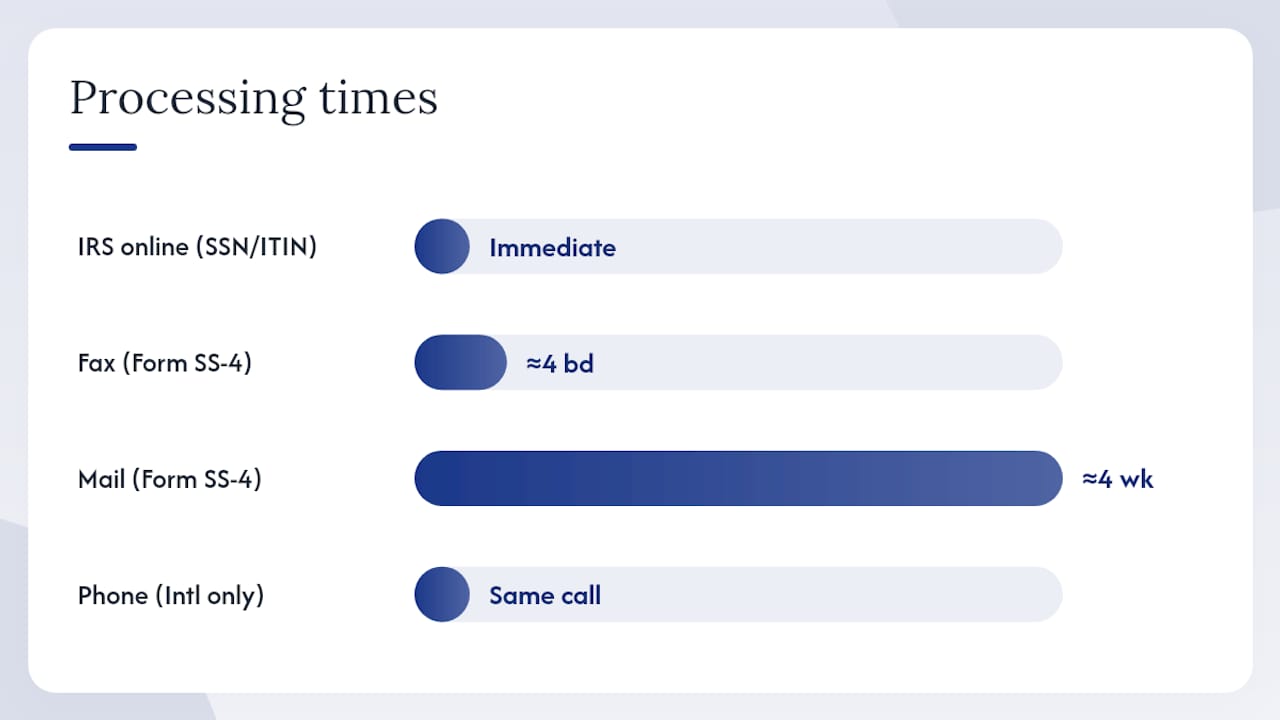
Form SS-4 is the official IRS form for applying for an EIN. It covers the same information as the online assistant and is the required method when the online tool is unavailable to you. Fax submissions typically receive a response within four business days. Mail submissions take considerably longer, often four weeks or more. The SS-4 instructions provide line-by-line guidance and confirm that the responsible party must have a valid taxpayer identification number to complete the application.
By phone for international applicants
If your principal place of business is outside the United States, call the IRS at 267-941-1099 (not a toll-free number) Monday through Friday, 6:00 AM to 11:00 PM Eastern Time. An IRS representative will ask you the same questions as Form SS-4 and issue the EIN by the end of the call.
Processing times at a glance
| Application method | Who can use it | Typical processing time |
|---|---|---|
| IRS online EIN Assistant | U.S.-based applicants with SSN or ITIN | Immediate |
| Fax (Form SS-4) | Any applicant | Approximately 4 business days |
| Mail (Form SS-4) | Any applicant | Approximately 4 weeks |
| Phone | International applicants only | Same call |
Pro Tip: The IRS issues EINs for free. Third-party services that charge a fee to "file your EIN application" are simply submitting the same free form on your behalf. Save the money and apply directly at IRS.gov.
Who is the "responsible party" and why does it matter?
Every EIN application requires you to identify a responsible party: the individual who owns or controls the entity, or who exercises ultimate effective control over it. For a single-member LLC, that is typically the owner. For a corporation, it is usually a principal officer.
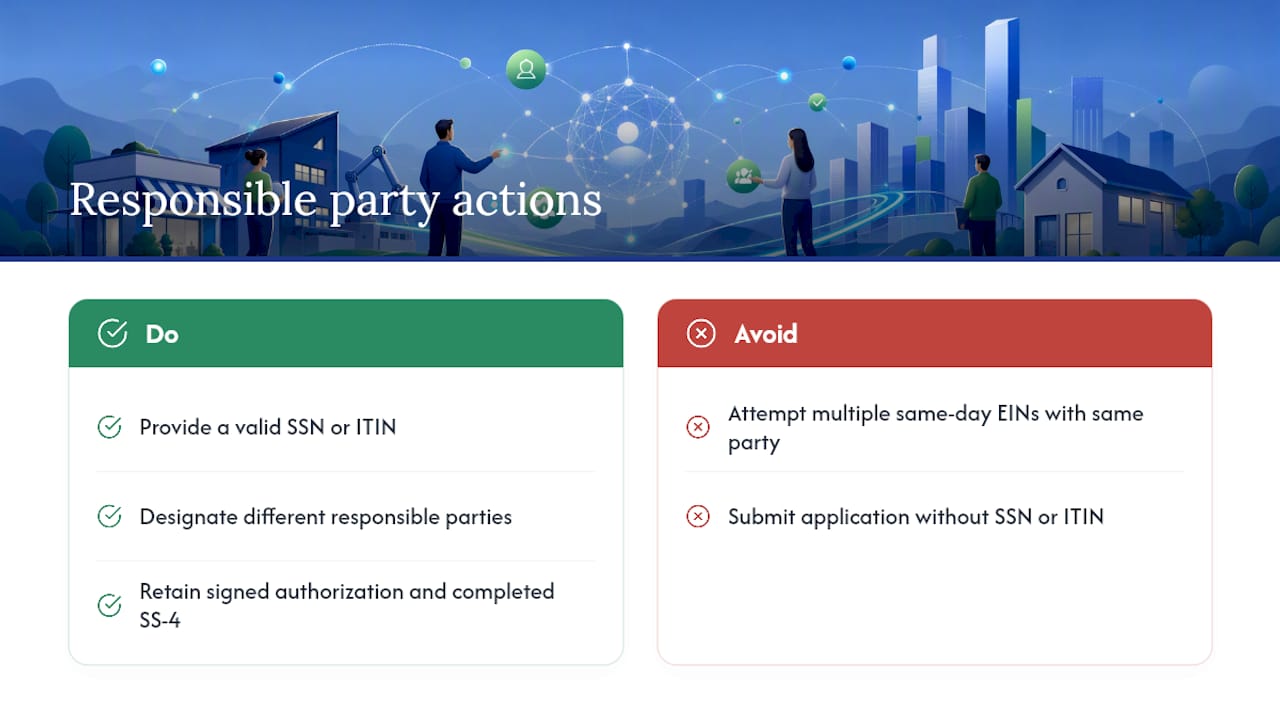
The responsible party must provide a valid SSN or Individual Taxpayer Identification Number (ITIN) on the application. The IRS requires this to create an audit trail and prevent anonymous business ownership. That connection between a personal tax ID and a business EIN is intentional: it ties accountability to a real individual.
There is a practical limit worth knowing. Effective May 21, 2012, the IRS limits EIN issuance to one per responsible party per day, across all application methods. If you are forming multiple entities at the same time, plan your filings accordingly or designate different responsible parties for each entity to avoid delays.
One EIN per responsible party per day is an IRS-enforced limit across all application methods, including online, fax, mail, and phone.
For third-party designees, such as an attorney or accountant applying on your behalf, retain a copy of the signed authorization and the completed SS-4. That documentation protects you if the IRS ever questions the application.
What is an EIN used for in day-to-day business?
Once you have your EIN, it appears on nearly every official document your business generates or receives. The most common uses include:
- Federal employment tax returns: Form 941 (quarterly payroll taxes) and Form 940 (annual FUTA return) both require your EIN.
- W-2 reporting: Your EIN identifies your business on every W-2 you issue to employees and on the W-3 transmittal to the SSA.
- Business income tax returns: Corporations file Form 1120 with their EIN; partnerships file Form 1065.
- 1099 series forms: Your EIN appears as the payer's tax ID on 1099-NEC, 1099-MISC, and related forms.
- Business bank accounts: Most banks require an EIN to open a business checking or savings account.
- State registrations and licenses: California's Employment Development Department (EDD), for example, requires your federal EIN when you register as an employer.
Publication 1635 is explicit on one point: an EIN is for business activities only. Never use it in place of your SSN on personal tax returns, personal loan applications, or any individual paperwork. Mixing the two creates reconciliation problems that can take significant time to untangle with the IRS.
How do you find your EIN if you've lost it?
Do not apply for a new EIN if you already have one. The IRS will not issue a second number for the same entity, and applying again creates confusion in your tax records. Instead, work through this recovery checklist:
- Check your IRS assignment notice. When you applied online, the assistant offered a printable confirmation. If you saved it, that document contains your EIN.
- Review prior tax returns. Your EIN appears on every federal business return you have filed, including Form 941, Form 940, Form 1120, or Schedule C.
- Check bank account paperwork. The EIN you provided when opening your business account is typically on file with your bank.
- Review payroll records or vendor correspondence. If you have processed payroll or issued 1099s, your EIN appears on those documents.
- Contact the IRS Business & Specialty Tax Line. Call 800-829-4933. An IRS representative can issue Letter 147C as official confirmation of your assigned EIN. Have your business name, address, and responsible party information ready.
Letter 147C is the IRS's official EIN verification letter and is accepted by banks, state agencies, and other institutions that need proof of your number.
Common EIN mistakes and how they affect payroll compliance
Getting an EIN is straightforward, but several common errors create downstream problems that show up during audits or payroll setup.
Mistakes to avoid:
- Applying before your state entity is formed. The SS-4 instructions specifically recommend forming your legal entity with the state before applying for an EIN. If your LLC or corporation is not yet registered with the state, the legal name on your SS-4 may not match your state records, causing mismatches on tax filings.
- Using an informal business name instead of the exact legal name. The name on your SS-4 must match the name registered with your state exactly, including punctuation and entity designators (LLC, Inc., etc.).
- Discarding the IRS confirmation letter. That document is your primary proof of EIN assignment. Store it with your permanent business records alongside your state formation documents. Good payroll process documentation practices include keeping this letter accessible for audits and bank requests.
- Misidentifying the responsible party. Listing a nominee or an entity rather than the actual controlling individual can trigger IRS scrutiny.
The EIN-to-state-registration connection in California
Obtaining a federal EIN is step one. For California employers, step two is registering with the Employment Development Department to establish your state employer account. The EDD requires your federal EIN during registration, and your EDD account number is what you use to remit State Disability Insurance (SDI) and Unemployment Insurance (UI) contributions. Skipping or delaying EDD registration after hiring employees exposes you to penalties under California law. The California payroll compliance guide from Glendale Payroll covers the full registration sequence.
Onboarding payroll checklist:
- Confirm state entity formation is complete and matches your SS-4 legal name
- Apply for your EIN online and print the confirmation immediately
- Register with California EDD using your federal EIN
- Set up federal and state payroll tax accounts before the first payroll run
- Retain the IRS confirmation letter and EDD registration confirmation in your permanent records
Pro Tip: Coordinate your EIN application timing with your payroll setup. Applying for the EIN on the same day you plan to run your first payroll can create a gap if the online assistant is unavailable. Apply at least a week before your first payroll date to give yourself a buffer for any technical issues.
Why getting the EIN process right matters more than most people realize
From Glendale Payroll's perspective, the EIN is not just a formality. It is the foundation of your entire federal and state tax identity as an employer. The most common problems we help clients resolve are not complex tax disputes — they are basic setup errors: a mismatched legal name between the SS-4 and the state registration, a lost confirmation letter that delays a bank account opening, or an EDD registration that was never completed because the owner assumed the federal EIN was sufficient.
For businesses in Glendale, Burbank, Pasadena, and Greater Los Angeles, the stakes are higher because California's employer obligations layer on top of federal requirements quickly. A free payroll audit from Glendale Payroll often surfaces these gaps before they become penalties. Getting the EIN right from the start, with the correct legal name, the right responsible party, and immediate coordination with state registration, is the single most effective way to avoid the compliance problems that cost small businesses real money.
Glendale Payroll handles what comes after your EIN
Once you have your EIN, the compliance work begins: payroll tax filings, W-2 preparation, new-hire reporting, and California EDD account setup all depend on getting that federal foundation right.

Glendale Payroll provides hands-on payroll processing and compliance support for small businesses across Glendale, Burbank, Pasadena, and Greater Los Angeles. Services include California EDD employer account setup, federal and state payroll tax filing, year-end W-2 preparation and distribution, and new-hire reporting — all handled by dedicated payroll professionals, not a call center. Every new client starts with a free payroll audit to identify gaps before they become penalties. For California payroll tips or to review your current setup, visit Glendale Payroll's services page and schedule your free audit today.
Sources
The following official sources are the most reliable references for EIN rules, application forms, and legal definitions:
- Get an employer identification number | Internal Revenue Service
- IRS Apply for an Employer Identification Number (EIN) online
- Instructions for Form SS-4 (12/2025) | Internal Revenue Service
This article is general information, not a substitute for advice from a qualified financial advisor. Consult a qualified financial professional about your own circumstances before acting on anything here.