
The California WARN Act (Cal-WARN), codified in California Labor Code sections 1400–1408, requires covered employers to provide 60 days' written notice before a mass layoff, plant closure, or relocation — and as of January 1, 2026, SB 617 adds new mandatory content to every notice, including a statement on service coordination, functioning contact information for the local workforce board, and a description of CalFresh benefits. If you are planning a workforce reduction at a California facility, this is the law that governs your obligations before you act.
Three facts to know before you do anything else:
- Covered establishment threshold: Any employer that employed 75 or more people (full-time and part-time combined) at a single California site during the preceding 12 months is covered.
- Required notice recipients: Affected employees or their union representatives, the California Employment Development Department (EDD), the local workforce development board, and the chief elected official of the city or county where the establishment is located.
- 2026 SB 617 additions: Notices issued on or after January 1, 2026 must state whether the employer will coordinate services with the local workforce board, include functioning email and phone contact information for that board and for the employer, describe available rapid response activities, and provide CalFresh information and the CalFresh helpline number.
The California Department of Industrial Relations (DIR) and its Labor Commissioner enforce these requirements. Noncompliance can mean back pay and benefits liability for up to 60 days per affected employee.
Key Takeaways
Cal-WARN requires 60 days' written notice to multiple recipients before any covered mass layoff, plant closure, or relocation, and SB 617 adds mandatory new content to every California notice issued on or after January 1, 2026.
| Point | Details |
|---|---|
| 60-day notice rule | Written notice must go out at least 60 calendar days before the effective date of any covered action. |
| Covered establishment threshold | Any California site with 75 or more employees in the preceding 12 months is covered, including part-time workers. |
| SB 617 notice additions | Notices issued on or after January 1, 2026 must include service coordination statements, workforce board contact info, and CalFresh details. |
| Noncompliance liability | Employers may owe back pay and benefits for up to 60 days per affected employee if notice is late or deficient. |
| Glendale Payroll's role | Glendale Payroll provides headcount exports, EDD account support, and payroll compliance audits to help California employers prepare accurate, timely WARN notices. |
Table of Contents
- What is the California WARN Act and does it apply to your business?
- Who receives the WARN notice and what must it say?
- What exceptions allow shorter notice or no notice at all?
- What are the penalties for violating Cal-WARN?
- Step-by-step: how to prepare and file a compliant WARN notice
- Federal WARN vs. California WARN: key differences you need to understand
- Common employer mistakes and how to avoid them
- A practical perspective on Cal-WARN from Glendale Payroll staff
- How Glendale Payroll supports Cal-WARN compliance for California employers
- Sources
What is the California WARN Act and does it apply to your business?
Cal-WARN applies at the establishment level, not the company level. That distinction matters because a large corporation with multiple California sites must analyze each location independently.
Covered establishment defined: Under Labor Code §1400.5, a covered establishment is any industrial or commercial facility that employed 75 or more persons during the 12-month period ending on the date of the order to close or lay off. Both full-time and part-time employees count toward that threshold. An employee who worked at least six months of the preceding 12 months counts as a full-time equivalent for this purpose.
Triggering events under Cal-WARN:
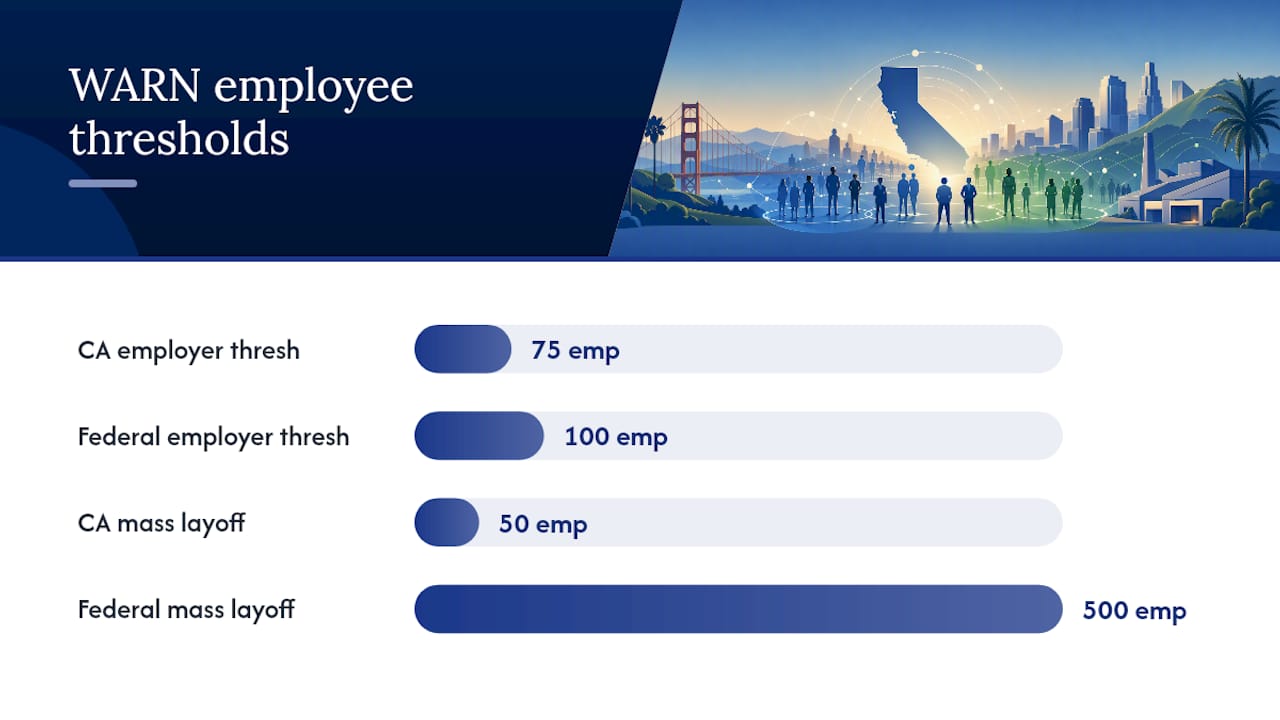
- Mass layoff: A layoff of 50 or more employees at a single covered establishment within any 30-day period, regardless of the percentage of the workforce affected.
- Plant closure: Any shutdown of a covered establishment, regardless of the number of employees affected. California does not require a minimum headcount for a plant closure trigger — this is a key difference from federal law.
- Relocation: Moving all or substantially all operations of a covered establishment to a different location 100 or more miles away.
- Call center relocation: Moving call center operations to a foreign country, regardless of the number of employees affected.
Applicability checklist — run these steps from your payroll and HR systems:
- Pull a 12-month headcount report for each California site, counting all employees (full-time and part-time) who worked at least six months in that period.
- Confirm whether any site reaches the 75-employee threshold.
- Identify the planned action: mass layoff, closure, relocation, or call center move abroad.
- For a mass layoff, count the number of employees losing employment within any 30-day window at that site.
- If the count reaches 50 or more at a covered establishment, Cal-WARN applies.
A note on aggregation: California allows the 30-day window to be extended to 90 days when an employer conducts multiple rounds of layoffs. If the combined total across those rounds reaches 50 or more, the entire sequence may be treated as a single triggering event.
The federal WARN Act, governed by 20 C.F.R. Part 639, generally requires 100 or more full-time employees at a single site before federal obligations attach. California's lower threshold of 75 employees means many mid-size employers who believe they are below the federal radar are still fully covered by Cal-WARN.
Who receives the WARN notice and what must it say?
Getting the recipient list right is as important as the 60-day timing. A notice delivered to the wrong parties — or missing a required recipient — can expose you to the same liability as no notice at all.
Required recipients:
- Each affected employee (or the employee's representative if covered by a collective bargaining agreement)
- The EDD's State Dislocated Worker Unit
- The local workforce development board serving the area where the establishment is located
- The chief elected official of each city and county government within which the layoff, closure, or relocation occurs
- Any applicable union representative
Required content — pre-2026 baseline:
Per Labor Code §1401, every Cal-WARN notice must include:
- The name and address of the employment site where the layoff, closure, or relocation will occur
- The name and telephone number of a company official to contact for further information
- A statement of whether the planned action is expected to be permanent or temporary
- The expected date of the first separation and the anticipated schedule of separations
- The job titles of positions to be affected and the names of the workers currently holding those jobs
SB 617 additions effective January 1, 2026:
Ogletree's analysis of SB 617 identifies four new required elements for notices issued on or after January 1, 2026:
- A statement of whether the employer plans to coordinate services with the local workforce development board or another entity
- Functioning email and telephone contact information for the local workforce development board serving the affected site
- A description of rapid response services available through the local board
- Information about CalFresh benefits, including the CalFresh helpline number
Sample notice checklist (use this to audit every draft):
| Notice Element | Required? | Example Language |
|---|---|---|
| Site name and address | Yes | "XYZ Corp., 123 Main St., Glendale, CA 91201" |
| Company contact name and phone | Yes | "HR Director Jane Smith, (818) 555-0100" |
| Permanent or temporary statement | Yes | "This action is expected to be permanent." |
| First separation date and schedule | Yes | "Separations begin March 1, 2026; all complete by March 31, 2026." |
| Job titles and employee names | Yes | Attach a roster by job title |
| Service coordination statement (SB 617) | Yes (2026+) | "Employer will / will not coordinate services with the local workforce board." |
| Local workforce board contact info (SB 617) | Yes (2026+) | Functioning email and phone for the applicable board |
| Rapid response services description (SB 617) | Yes (2026+) | Brief description of available reemployment services |
| CalFresh info and helpline (SB 617) | Yes (2026+) | CalFresh helpline |
Pro Tip: Contact the local workforce development board before you finalize the notice. Board contact information changes, and SB 617 specifically requires that the contact details be "functioning" — a disconnected phone number or outdated email address in the notice creates a compliance defect on its face.
Official filing addresses and submission guidance are available directly through the EDD WARN page and the DIR Cal-WARN page.
What exceptions allow shorter notice or no notice at all?
Cal-WARN provides a narrow set of statutory exceptions. None of them eliminate the notice obligation entirely — they allow shorter notice when circumstances genuinely prevent the full 60 days. Misusing an exception is one of the fastest ways to trigger back-pay liability.
Recognized exceptions under Labor Code §1402 and §1402.5:
- Unforeseeable business circumstances: A sudden, dramatic, and unexpected action or condition outside the employer's control — such as an abrupt loss of a major contract — that makes 60 days' notice impossible. The employer must give as much notice as practicable and explain the circumstances in the notice itself.
- Natural disaster or physical calamity: A flood, earthquake, or similar event that directly causes the closure or layoff. The notice must state the natural disaster as the reason.
- Faltering company: Available only for plant closures. The employer must have been actively seeking capital or business that, if obtained, would have allowed the plant to remain open, and must have had a reasonable belief that advance notice would have prevented obtaining that capital.
- Completion of a particular project: Employers in the construction, drilling, logging, or mining industries may be exempt when the layoff results from the completion of a specific project and employees were hired with the understanding that employment was limited to that project.
- Seasonal employment: Layoffs resulting from the end of a seasonal operation, where employees were hired with the understanding that employment was seasonal.
- DIR exemption under §1402.5: An employer may petition the Director of Industrial Relations for an exemption by demonstrating active efforts to seek capital or business that would prevent the closure or layoff.
How to request a DIR exemption — step by step:
- Prepare a written petition addressed to the Director of Industrial Relations documenting the specific grounds for exemption.
- Attach supporting evidence: audited financials, board minutes reflecting the decision timeline, correspondence with potential investors or buyers, and any term sheets or letters of intent.
- Submit the petition as early as possible — the Director's determination is not guaranteed, and you remain liable if the exemption is denied.
- Issue whatever notice is practicable while the petition is pending; waiting for a ruling before notifying anyone compounds the risk.
- Retain all documentation. If the exemption is later challenged, your evidence file is your primary defense.
Using an exception improperly — for example, claiming "unforeseeable circumstances" for a planned restructuring that was discussed in board meetings months earlier — does not shield the employer. Courts and the Labor Commissioner look at what the employer knew and when. If internal communications show the layoff was foreseeable, the exception will not hold, and the full 60-day back-pay liability attaches.
What are the penalties for violating Cal-WARN?
The DIR's enforcement guidance is direct: an employer who fails to provide the required Cal-WARN notice may be liable to each affected employee for back pay and the value of lost benefits for up to 60 days, or one-half the number of days the employee was employed, whichever is less.
How the liability calculation works — a practical example:
Assume an employer closes a Glendale facility with 80 employees and provides zero notice. Each employee earns $200 per day in wages and benefits combined. The maximum exposure per employee is 60 days × $200 = $12,000. For 80 employees, total exposure reaches $960,000 before any offsets.
Offsets that may reduce liability:
- Wages paid during any period of violation
- Voluntary and unconditional payments made to the employee after the order to close
- WARN-related payments made pursuant to a legal settlement
Enforcement pathways:
- The Labor Commissioner and DIR have authority to investigate complaints, conduct audits, and seek remedies on behalf of affected employees.
- Employees may also bring a civil action directly in California superior court.
- The EDD and local workforce boards may refer cases to the Labor Commissioner when they identify missing or deficient notices.
Common triggers that lead to investigations:
- Late notices filed after the 60-day window has already closed
- Notices missing the SB 617 elements (contact info, service coordination statement, CalFresh details)
- Inconsistent headcount records that suggest the employer knew the threshold was met but delayed notice
- Complaints filed by affected employees or union representatives with the Labor Commissioner
Step-by-step: how to prepare and file a compliant WARN notice
A compliant Cal-WARN filing is a process, not a single document. The steps below follow a 90-day planning cadence that gives your team enough runway to get it right.
Step 1: Run the applicability analysis (Day -90 to -75)
- Pull a 12-month headcount export from your payroll system for each California site.
- Confirm whether any site meets the 75-employee covered establishment threshold.
- Identify the triggering event and count the employees affected within the relevant 30-day window.
- Confirm the planned effective date of the action.
Step 2: Assemble notice content and recipient information (Day -75 to -65)
- Identify and verify contact information for the local workforce development board serving each affected site.
- Confirm the name and contact details of the chief elected official for the relevant city and county.
- Draft the notice using the checklist in the section above, including all SB 617 elements.
- Have legal counsel review the draft before it goes out.
Step 3: Issue and file the notice (Day -60)
- Deliver notice to each affected employee (or union representative) by certified mail or in-person delivery; email is permissible when the employee has consented to electronic communications.
- File simultaneously with the EDD State Dislocated Worker Unit, the local workforce development board, and the chief elected official.
- Retain proof of delivery for every recipient.
Step 4: Coordinate rapid response services if applicable (Day -60 to Day -30)
Per Ogletree's SB 617 guidance, if the employer states in the notice that it will coordinate services with the local workforce board, those services must be arranged within 30 days of the written notice. Contact the board immediately after filing to schedule rapid response activities.
Filing timeline at a glance:
Pro Tip: Notify your payroll vendor — including Glendale Payroll if they process your payroll — at the same time you issue the WARN notice. Final paycheck calculations, severance processing, and EDD employer account updates all need to be coordinated before the effective date, and a 60-day window goes faster than it looks.
Federal WARN vs. California WARN: key differences you need to understand
California's law is broader than federal law on nearly every dimension that matters to mid-size employers. Relying on federal compliance alone is a documented compliance failure after SB 617.
| Dimension | Federal WARN (29 U.S.C. §2101) | California WARN (Labor Code §1400–1408) |
|---|---|---|
| Employer threshold | 100+ full-time employees | 75+ employees (full-time and part-time) in preceding 12 months |
| Mass layoff trigger | 50+ employees AND 33% of workforce, or 500+ employees | 50+ employees at a covered establishment within 30 days (no percentage requirement) |
| Plant closure trigger | Any size, but employer must meet 100-employee threshold | Any size closure of a covered establishment |
| Call center relocation | Not specifically covered | Foreign relocation of call center operations triggers notice regardless of headcount |
| Notice recipients | Employees/reps, state dislocated worker unit, local elected official | Same, plus local workforce development board |
| SB 617 notice content | Not required | Required as of January 1, 2026 (service coordination, board contact, CalFresh) |
| Enforcement | Federal court; WARN Act civil actions | Labor Commissioner/DIR; California superior court |
Littler's analysis makes the practical implication clear: employers who operate in multiple states and use a single federal WARN template for all locations are no longer compliant in California after SB 617. Each California notice must be drafted separately, with localized workforce board contact information and the new SB 617 language.
For multi-state employers, the safest approach is to treat California as a separate compliance track. Run the Cal-WARN applicability analysis for each California site independently, and maintain a California-specific notice template that is updated annually to reflect any legislative changes.
Common employer mistakes and how to avoid them
Most Cal-WARN enforcement actions stem from a handful of recurring errors, not from employers who ignored the law entirely. The mistakes below are the ones that most often result in back-pay liability.
Compliance checklist — audit these items now:
- Review your current notice template. If it was drafted for federal WARN compliance only, it is missing the SB 617 elements required in California as of January 1, 2026.
- Verify local workforce board contact information. Board contacts change. Confirm the current functioning email and phone number for every California site you operate.
- Audit your headcount records. Maintain a rolling 12-month headcount export by site so you can determine covered establishment status within hours, not days, when a workforce action is being considered.
- Assign a WARN governance owner. Someone in HR or legal must own the Cal-WARN compliance process, track legislative changes, and update templates annually.
- Coordinate with payroll operations early. Payroll data is the primary evidence base for the applicability analysis. Your payroll vendor needs to be part of the WARN planning process.
The most common mistakes:
- Using a federal-only WARN template for California notices — Littler specifically cautions against this after SB 617
- Miscounting part-time employees by excluding them from the covered establishment threshold
- Failing to notify the local workforce development board as a separate required recipient
- Ignoring the 30-day rapid response coordination deadline when the notice states the employer will coordinate services
- Treating a multi-round layoff as separate events when the 90-day aggregation rule may combine them into a single triggering event
Pro Tip: Build a pre-approved legal notice clause bank with your labor counsel. Draft and approve the SB 617 language blocks — the service coordination statement, the workforce board contact template, and the CalFresh paragraph — before any workforce action is on the table. When a WARN event happens, you fill in the site-specific details rather than drafting under pressure.
Compliance in recruiting and HR communications during layoffs also benefits from a coordinated approach. The HR compliance guidance from JobsAI Enterprise covers how compliance obligations interact with broader HR processes, which is useful context for teams managing both WARN notices and ongoing hiring.
A practical perspective on Cal-WARN from Glendale Payroll staff
The most consistent challenge we see with Cal-WARN events is not that employers don't know the law exists. It's that the payroll data needed to run the applicability analysis is scattered across multiple systems, and no one has pulled a clean 12-month headcount report by site before the workforce action is already in motion. By the time HR realizes the 75-employee threshold is met, the 60-day clock is already running short.

The coordination between payroll operations, HR, and the local workforce board is also more time-sensitive than most employers expect. The SB 617 requirement to arrange rapid response services within 30 days of the notice means the workforce board conversation needs to happen immediately after the notice goes out, not after the effective date. Payroll records, final wage calculations, and EDD account information all need to be ready at the same time.
Glendale Payroll supports clients through this process by providing rapid headcount exports, maintaining accurate EDD employer account records, and coordinating with HR and legal counsel on the payroll data components of the notice. A payroll compliance audit before any workforce action is the most effective way to confirm your records are accurate and your notice will hold up to scrutiny.
How Glendale Payroll supports Cal-WARN compliance for California employers
Cal-WARN compliance depends on accurate payroll data, and that data needs to be ready before the 60-day clock starts. Glendale Payroll gives California employers in Glendale, Burbank, Pasadena, and Greater Los Angeles a concrete advantage: dedicated payroll professionals who know your headcount records, your EDD account, and your California-specific filing obligations — not a call center that picks up the phone when you're already in crisis.

When a workforce action is being planned, Glendale Payroll can pull site-level headcount exports, verify covered establishment status, prepare final wage and benefit calculations, and coordinate with your HR team and legal counsel on the payroll data components of the WARN notice. The free payroll compliance audit identifies gaps in your records before they become enforcement exposure. For employers who want to stay ahead of Cal-WARN and California's broader payroll compliance requirements, the California Payroll Compliance Guide is the right starting point. To review the full range of services and schedule a consultation, visit Glendale Payroll's services page.
Sources
The sources below are the primary references for Cal-WARN compliance. Each covers a distinct part of the framework.
- Worker Adjustment and Retraining Notification (WARN) - EDD
- Codes Display Text - California Legislature (Labor Code sections 1400–1408)
- Cal-WARN Act - California Department of Industrial Relations
This article is general information, not a substitute for advice from a qualified lawyer. Consult a qualified legal professional about your own circumstances before acting on anything here.