
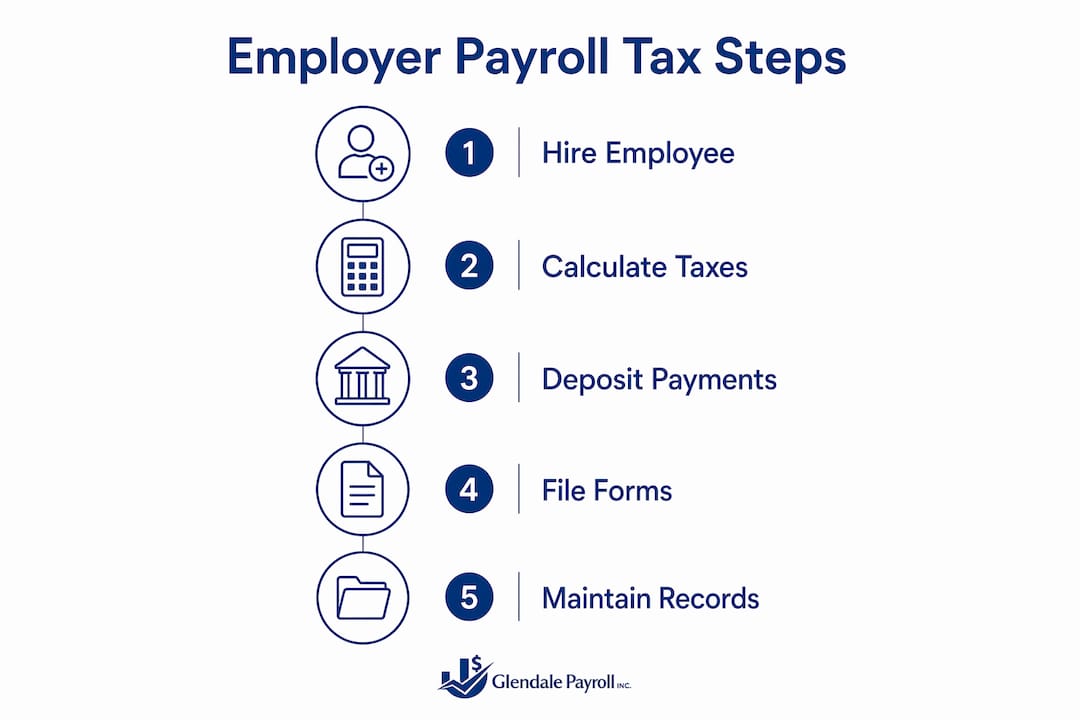
Employer payroll tax is the collective term for taxes you, as an employer, must either withhold from employee wages and remit to the government or pay directly from your own funds. Every time you run payroll, two categories of obligations come due simultaneously: amounts you hold in trust on behalf of your employees (federal income tax withheld, employee shares of Social Security and Medicare) and taxes that are entirely your cost (the employer shares of Social Security and Medicare, FUTA, and state unemployment). Your immediate next steps: confirm your deposit schedule with the IRS, register for EFTPS if you haven't already, and make sure you're filing the right forms each quarter and year.
The main payroll taxes employers encounter:
- Employer share of Social Security: a fixed percentage on wages up to the annual wage base
- Employer share of Medicare: a fixed percentage on all wages, with no cap
- Federal Unemployment Tax (FUTA): employer-only, nominally a set rate on the first segment of wages, typically reduced with the state credit
- State Unemployment Tax (SUTA): rates and wage bases vary by state
- Withheld federal income tax: legally the employee's tax, but you hold it in trust and are fully responsible for depositing it on time
- Withheld employee FICA: same trust-fund status as withheld income tax
Check your deposit schedule (monthly or semiweekly) and confirm you're using Form 941 for quarterly reporting, Form 940 for annual FUTA, and W-2s for year-end employee reporting. If you're unsure where to start, a payroll provider or CPA can map out your specific obligations quickly.
Table of Contents
- What do employer payroll taxes actually cover?
- What are the FICA rates and wage-base rules for 2026?
- How do FUTA and SUTA work, and who actually pays them?
- How to calculate your employer payroll tax costs
- What IRS forms and deposit schedules do you need to follow?
- What happens when payroll tax deposits are missed?
- Payroll tax vs. income tax: who legally pays and who really bears the cost
- A practical compliance checklist for small employers
- Key Takeaways
- Why payroll tax compliance deserves your full attention
- How Glendale Payroll helps you stay compliant and penalty-free
- Authoritative sources for rates, forms, and deposit rules
What do employer payroll taxes actually cover?
The legal split between employer-paid taxes and withheld employee taxes matters more than most small business owners realize. Confusing the two categories is one of the most common sources of compliance problems.
Employer-paid taxes are costs you absorb directly. The employer share of Social Security (6.2%) and Medicare (1.45%), FUTA, and SUTA all come out of your operating funds. Employees never see these amounts on their pay stubs because they're not deducted from wages.

Withheld taxes are a different matter entirely. Federal income tax and the employee shares of Social Security and Medicare are deducted from employee wages, but the moment you deduct them, they stop being your money. The IRS treats withheld amounts as government property held in trust by the employer. You are the custodian, not the owner.
Here's why that distinction carries serious weight:
- Employer-paid taxes (FUTA, employer FICA) are business liabilities — serious, but treated like other tax debts.
- Withheld taxes are trust-fund obligations. Failing to deposit them triggers the Trust Fund Recovery Penalty (TFRP), which can make you personally liable even if your business is an LLC or corporation.
- FUTA is employer-only; employees never contribute to it and it is never withheld from their pay.
Pro Tip: Open a dedicated payroll tax account and transfer withheld amounts into it the same day you run payroll. Treating those funds as untouchable from day one is the single most effective control a small employer can put in place.
What are the FICA rates and wage-base rules for 2026?
FICA, which funds Social Security and Medicare, is the largest payroll tax obligation for most employers. The rates are set by federal law and apply uniformly across the country.
For 2026, the Social Security wage base sets the maximum wage amount subject to Social Security tax. Both employer and employee pay a fixed percentage on wages up to that threshold, after which Social Security tax no longer applies for the year.
Medicare works differently. A fixed percentage rate applies to all wages without any wage-base cap. Every dollar of wages is subject to Medicare tax.
FICA at a glance: Social Security is taxed at fixed percentages for employer and employee on wages up to the Social Security wage base. Medicare is taxed at fixed percentages on all wages without limit.
One additional rule catches many employers off guard. Per Form 941 instructions (03/2026), once you pay any single employee above a specified wage threshold in a calendar year, you must begin withholding an Additional Medicare Tax on wages above that threshold. This is an employee-only tax. There is no employer match, but you are responsible for withholding it accurately and reporting it on Form 941.
Key FICA facts for your payroll budget:
- Employer Social Security: a fixed percentage per employee, up to the Social Security wage base
- Employer Medicare: a fixed percentage per employee, unlimited
- Additional Medicare Tax: an employee-only withholding that begins once employee wages exceed a specified threshold
- Combined employer FICA cost per employee: a set combined rate applies to wages up to the Social Security wage base, then a different rate on wages above it.
How do FUTA and SUTA work, and who actually pays them?
Federal and state unemployment taxes fund the unemployment insurance system. Both are employer-only obligations; neither is withheld from employee wages.

FUTA is nominally 6.0% on the first $7,000 of each employee's wages. In practice, most employers pay far less. If you pay your state unemployment taxes on time, you qualify for a FUTA credit of up to 5.4%, which reduces your effective federal rate to 0.6%. On a $7,000 wage base, that's $42 per employee per year at the effective rate. States with federal loans can lose part of this credit (called FUTA credit reduction), so check the IRS credit reduction list each November if you operate in a state with high unemployment fund debt.
FUTA deposit timing follows a specific rule. You only need to make a quarterly FUTA deposit when your cumulative FUTA liability for the quarter exceeds $500. If it stays at or below $500, you carry the liability forward and pay it with your annual Form 940 filing.
SUTA is where things get state-specific. Every state sets its own:
- Taxable wage base (often higher than the federal $7,000)
- Tax rate, which varies by employer experience rating (your claims history)
- Filing and payment schedule
New employers typically receive an assigned rate until they build enough history for an experience rating. Check your state's unemployment agency for your current rate and wage base. California employers, for example, deal with the Employment Development Department (EDD) for SUTA, which has its own rate schedule and wage base distinct from federal rules. For state-specific guidance, California payroll tips from Glendale Payroll cover the EDD requirements in detail.
How to calculate your employer payroll tax costs
Here's a repeatable process you can apply every pay period.
Step-by-step calculation
- Determine gross wages for each employee for the pay period.
- Calculate employee withholdings: federal income tax (using Form W-4 and Publication 15-T tables), employee Social Security (6.2% up to annual wage base), employee Medicare (1.45%), and Additional Medicare Tax if applicable.
- Calculate employer FICA: 6.2% Social Security on wages up to the wage base + 1.45% Medicare on all wages.
- Calculate FUTA: 0.6% on the first $7,000 of wages per employee per year (assuming full state credit).
- Calculate SUTA: apply your state rate to your state's taxable wage base.
- Sum employer-only costs (employer FICA + FUTA + SUTA) to get your total payroll cost above gross wages.
Worked example
Assume one employee earning $5,000 gross wages this pay period, with $20,000 in cumulative wages for the year so far (well below the Social Security wage base and FUTA/SUTA wage bases).
| Employer cost component | Calculation | Amount |
|---|---|---|
| Employer Social Security | $5,000 × 6.2% | $310.00 |
| Employer Medicare | $5,000 × 1.45% | $72.50 |
| FUTA (effective rate) | $5,000 × 0.6% | $30.00 |
| SUTA (sample rate) | $5,000 × sample rate | amount |
| Total employer cost above gross wages | total amount |
Total payroll cost for this employee this period includes the gross wages plus employer taxes.
Replace the sample SUTA rate with your actual state rate, and verify the current Social Security wage base ($184,500 for 2026) each January. Once cumulative wages exceed the FUTA wage base ($7,000) or your state's SUTA wage base, those taxes stop for that employee for the remainder of the year.
Pro Tip: Build a simple spreadsheet that tracks each employee's cumulative wages against the Social Security, FUTA, and SUTA wage bases. When an employee crosses a threshold mid-year, your employer cost drops noticeably — knowing that in advance helps with cash flow planning.
What IRS forms and deposit schedules do you need to follow?
Payroll tax compliance is as much about timing as it is about accuracy. Filing the right form late is treated the same as not filing at all.
Core forms
- Form 941: Filed quarterly. Reports federal income tax withheld, employee and employer Social Security and Medicare taxes. Most employers use this form. Employment tax due dates and filing guidance are on the IRS website.
- Form 940: Filed annually. Reports your FUTA liability for the year. Due January 31 (or February 10 if all FUTA taxes were deposited on time).
- Form W-2: Furnished to employees and filed with the Social Security Administration by January 31 each year.
- Form W-3: Transmittal form submitted to SSA along with W-2s.
- Forms 943/944/945: Used by agricultural employers (943), very small employers approved for annual filing (944), and employers reporting backup withholding (945) — less common but worth knowing.
All federal tax deposits must go through EFTPS. Register early; EFTPS enrollment can take up to five business days to activate.
Deposit frequency
Your deposit schedule is determined by your lookback period — the total employment taxes reported during a 12-month period ending June 30 of the prior year. The IRS deposit rules are clear on this.
| Lookback period tax liability | Deposit schedule |
|---|---|
| — | Monthly (deposit by the 15th of the following month) |
| — | Semiweekly (deposit Wednesday–Friday payrolls by the following Wednesday; Saturday–Tuesday payrolls by the following Friday) |
| $100,000+ in a single day | Next business day (regardless of regular schedule) |
New employers with no lookback period default to monthly. Your schedule is set for the full calendar year — it doesn't change mid-year unless you trigger the $100,000 next-day rule. A payroll date management guide can help you build a deposit calendar so deadlines don't slip.
What happens when payroll tax deposits are missed?
Missing a payroll tax deposit is one of the most costly mistakes a small employer can make. The IRS does not treat it like a late invoice.
Trust-fund taxes are government property. The moment you withhold federal income tax or employee FICA from a paycheck, those funds belong to the U.S. Treasury. You are holding them in trust. Spending them on operating expenses, even temporarily, is not a cash flow solution — it's a federal compliance violation.
Common penalties you face when deposits are late or missed:
- Failure-to-deposit penalty: Ranges from 2% (1–5 days late) to 15% (more than 10 days after the first IRS notice), applied to the undeposited amount.
- Trust Fund Recovery Penalty (TFRP): The IRS can assess this against any "responsible person" — owner, officer, or anyone with authority over payroll funds. It equals 100% of the unpaid trust-fund taxes and is a personal liability, not a business liability. An LLC or corporation structure does not shield you from TFRP.
- Interest: Accrues daily on unpaid balances from the due date.
- Criminal exposure: In cases of willful failure to collect or pay over taxes, criminal prosecution is possible, though rare for first-time, non-fraudulent situations.
If you can't make a deposit, act immediately:
- Contact the IRS or a payroll specialist before the deadline passes, not after.
- Make the largest partial deposit you can — penalties are assessed on the undeposited amount, so every dollar deposited reduces exposure.
- File all required returns on time even if you can't pay in full — late filing adds a separate penalty.
- Request a payment plan (installment agreement) through the IRS.
- Engage a CPA or payroll compliance specialist to help correct returns and negotiate with the IRS.
Pro Tip: If cash is tight, pay payroll taxes before any other vendor. The failure-to-deposit penalty and TFRP together can exceed the original tax amount. No vendor invoice carries that kind of personal liability.
Payroll tax vs. income tax: who legally pays and who really bears the cost
The legal responsibility for payroll taxes and the economic burden of those taxes are two different things. Understanding both helps you make smarter hiring and compensation decisions.
Legally:
- Employers are responsible for withholding federal income tax from employee wages and remitting it to the IRS. The employee owes the tax; the employer is the collection agent.
- FICA is split by law: each party pays half. The employer's share is a separate legal liability, not a deduction from wages.
- FUTA is entirely the employer's legal obligation.
Economically:
The Tax Foundation's research on payroll tax incidence notes that employers often shift the cost of their payroll tax share to workers through lower wages over time. In a competitive labor market, total compensation (wages plus employer taxes plus benefits) is what employers can afford to pay. When employer payroll taxes rise, wages tend to adjust downward to keep total compensation within budget. This doesn't happen overnight, but it's a real dynamic in compensation planning.
Practical implications for your budget:
- When you hire a $60,000-per-year employee, your actual cost is closer to $64,500–$65,000 once you add employer FICA, FUTA, and SUTA.
- Payroll taxes are a deductible business expense, which partially offsets the cost.
- For payroll tax planning purposes, model total employment cost per hire, not just gross salary.
A practical compliance checklist for small employers
Most payroll tax problems are preventable. The following steps address the specific controls that small employers most often skip.
- Register for an EIN with the IRS before your first payroll. You cannot file or deposit without one.
- Enroll in EFTPS immediately after getting your EIN. Allow up to five business days for activation.
- Open a dedicated payroll tax bank account and transfer withheld amounts into it on every pay date.
- Collect a completed Form W-4 from every new hire before the first paycheck. Update records when employees submit revised W-4s.
- Document your pay policies in writing: pay frequency, overtime rules, bonus timing, and expense reimbursement procedures. Consistent payroll process documentation reduces errors and audit exposure.
- Build a payroll calendar that lists every deposit deadline and filing due date for the year. Mark FUTA quarterly checkpoints ($500 threshold) and Form 941 due dates.
- Reconcile payroll every pay period: compare gross wages, withholdings, and employer taxes to your general ledger. Catch errors before they compound.
- Retain payroll records for at least four years per IRS guidance, including W-4s, pay stubs, tax deposit records, and filed returns.
Common pitfalls that trigger audits and penalties:
- Misclassifying employees as independent contractors (1099 workers) to avoid FICA and FUTA
- Missing FUTA quarterly deposit thresholds
- Mixing withheld tax funds with operating cash
- Incorrect SUTA coding when employees work in multiple states
Pro Tip: If your headcount grows past 10 employees, you operate in more than one state, or you add complex benefits like stock options or health reimbursement arrangements, those are clear signals to bring in a dedicated payroll service. The cost of outsourcing is almost always less than one penalty assessment. Automating payroll processing also eliminates the manual calculation errors that most small employers don't catch until the IRS does.
Key Takeaways
Employer payroll taxes are a legal obligation that begins with your first hire and carries personal liability risk if withheld funds are not deposited on time.
| Point | Details |
|---|---|
| Employer payroll tax definition | Taxes employers must withhold from wages and/or pay directly, including FICA, FUTA, and SUTA. |
| 2026 FICA rates | Employer pays 6.2% Social Security (up to $184,500 wage base) and 1.45% Medicare on all wages. |
| Trust-fund risk | Withheld taxes are government property; missing deposits can trigger personal liability via the TFRP. |
| Deposit schedule | Monthly or semiweekly based on your lookback period; use EFTPS for all federal deposits. |
| Glendale Payroll | Offers payroll processing, tax deposits, and compliance monitoring, plus a free payroll audit for employers who want to verify their current setup. |
Why payroll tax compliance deserves your full attention
Payroll tax compliance is one of those areas where the consequences of getting it wrong are disproportionately severe compared to the effort required to get it right. The IRS does not distinguish between an employer who intentionally diverted trust-fund taxes and one who simply ran out of cash and made a bad decision under pressure. The Trust Fund Recovery Penalty applies in both cases.
What we see repeatedly at Glendale Payroll is that the employers who run into serious IRS problems are rarely the ones who were trying to cut corners. They're the ones who grew faster than their payroll process could keep up with, or who didn't realize that their bookkeeper was handling deposits manually without a proper calendar. By the time the IRS sends a notice, the liability has compounded with penalties and interest to a number that's genuinely difficult to resolve without professional help.
The free payroll audit Glendale Payroll offers exists precisely for this reason. A thorough review of your current deposit history, form filings, and withholding calculations takes less than an hour and can surface problems before they become IRS correspondence. If your payroll process is solid, the audit confirms it. If there are gaps, you find out on your terms, not the government's.
How Glendale Payroll helps you stay compliant and penalty-free
Payroll tax compliance isn't a one-time setup. It's an ongoing process of calculating, depositing, reconciling, and filing on a schedule that doesn't pause for busy seasons or cash flow crunches. That's exactly where a dedicated payroll service earns its cost.

Glendale Payroll handles payroll processing, federal and state tax deposits via EFTPS, Form 941 and Form 940 filing, W-2 preparation, and ongoing compliance monitoring for employers across Glendale, Burbank, Pasadena, and Greater Los Angeles. Unlike firms that route your calls to a general support queue, Glendale Payroll assigns dedicated payroll professionals to each client. You get someone who knows your account, your deposit schedule, and your state-specific SUTA obligations.
The starting point for new clients is a free comprehensive payroll audit. It's a no-obligation review of your current payroll setup, deposit history, and filing status. If you want to confirm your compliance before the next Form 941 due date, or if you've received an IRS notice and need to understand your exposure, that audit is the right first step. Explore Glendale Payroll's services or visit glendalepayroll.com to schedule your free audit today.
This article is general information, not legal or tax advice. Confirm current rates, deposit schedules, and filing requirements with the IRS, your state unemployment agency, or a qualified tax professional for your specific situation.
Authoritative sources for rates, forms, and deposit rules
Use these primary sources to verify current-year figures and deadlines directly.
- IRS Publication 15 (Employer's Tax Guide): The definitive employer reference for withholding rules, deposit schedules, corrective procedures, and trust-fund obligations. Updated annually.
- IRS — Understanding Employment Taxes: Plain-language overview of all employment tax types and employer responsibilities.
- IRS — Form 941 Instructions (03/2026): Quarterly reporting requirements, Additional Medicare Tax rules, and line-by-line guidance.
- IRS — Form 940 and FUTA Deposit Rules (Topic No. 759): FUTA deposit threshold, credit reduction information, and annual filing instructions.
- IRS — Depositing and Reporting Employment Taxes: Deposit frequency rules, lookback period explanation, and EFTPS enrollment.
- IRS — Trust Fund Recovery Penalty: Full explanation of TFRP, responsible-person definition, and penalty assessment process.
- IRS — Employment Tax Due Dates: Filing and deposit deadlines for all employment tax forms.
- EFTPS — Electronic Federal Tax Payment System: Official portal for enrolling and making all federal tax deposits.
- Social Security Administration — Contribution and Benefit Base: Annual Social Security wage base and OASDI/HI rate verification.
- Tax Foundation — Payroll Tax (TaxEDU): Accessible explainer on payroll tax incidence, revenue role, and economic impact.
- State unemployment agency: Search "[your state] unemployment insurance tax" to find your state's current SUTA rate schedule, wage base, and filing portal. California employers should go directly to the Employment Development Department (EDD) at edd.ca.gov.