
Employment tax is the set of federal taxes you must withhold from employee wages and/or pay as the employer, covering federal income tax withholding, Social Security and Medicare (FICA), and the Federal Unemployment Tax (FUTA). Per IRS guidance, every employer with at least one paid employee carries three core obligations: withhold the correct amounts each pay period, deposit those funds on a strict schedule, and file the required returns on time.
Your most urgent first steps:
- Get your Employer Identification Number (EIN) from the IRS before your first payroll run.
- Register with EFTPS (the Electronic Federal Tax Payment System) so you can make timely deposits.
- Collect a completed Form W-4 from every new hire before processing their first paycheck.
- Determine your deposit schedule (monthly or semiweekly) based on your lookback period.
- Know your forms: Form 941 (quarterly), Form 940 (annual FUTA), and Form W-2 (annual wage statement).
Table of Contents
- What is employment tax, and what is its legal basis?
- What are the main types of employment taxes?
- Who pays employment taxes, and what are your responsibilities as an employer?
- How do you calculate withholding each pay period?
- When and how do you deposit and report employment taxes?
- What penalties do small employers face, and how do you avoid them?
- What state and local employment taxes do you also owe?
- Your employment tax compliance checklist
- Key Takeaways
- The compliance mindset most employers get wrong
- Glendale Payroll takes the compliance burden off your plate
- Useful sources for employers
What is employment tax, and what is its legal basis?
Employment taxes are defined and imposed by Subtitle C of the Internal Revenue Code. Chapter 21 covers FICA (Social Security and Medicare), Chapter 23 covers FUTA, and Chapter 24 covers income tax collection at source. Under 26 U.S. Code § 3401, "wages" is the statutory term that triggers withholding obligations, and every employer paying wages must collect income tax at the source.
The concept that catches many small employers off guard is trust fund taxes. When you withhold federal income tax and the employee's share of FICA from a paycheck, those funds do not belong to your business. They belong to the federal government, held in trust by you until deposited. Publication 15 (Circular E) is the IRS's primary employer guide and the definitive reference for withholding, depositing, and reporting rules.
"The federal income tax withheld and the employees' share of Social Security and Medicare taxes are called trust fund taxes because you hold these funds in trust until you make a federal tax deposit." — IRS Publication 15
Misusing those funds, even temporarily to cover a cash shortfall, is one of the most serious compliance errors an employer can make. The legal and financial consequences are covered in the penalties section below.
What are the main types of employment taxes?
Understanding employment taxes identifies four primary categories. Here is a concise breakdown of each, including who pays what.
| Tax | Who Pays | Current Rate | Wage Base / Threshold |
|---|---|---|---|
| Federal income tax withholding | Employee (withheld by employer) | Varies by W-4 and bracket | No cap |
| Social Security (FICA) | Employee + Employer (each) | 6.2% each | Annual wage base (see IRS) |
| Medicare (FICA) | Employee + Employer (each) | 1.45% each | No cap |
| Additional Medicare Tax | Employee only (withheld by employer) | 0.9% | Wages above $200,000 |
| FUTA | Employer only | 6.0% (credit reduces effective rate) | First $7,000 per employee |
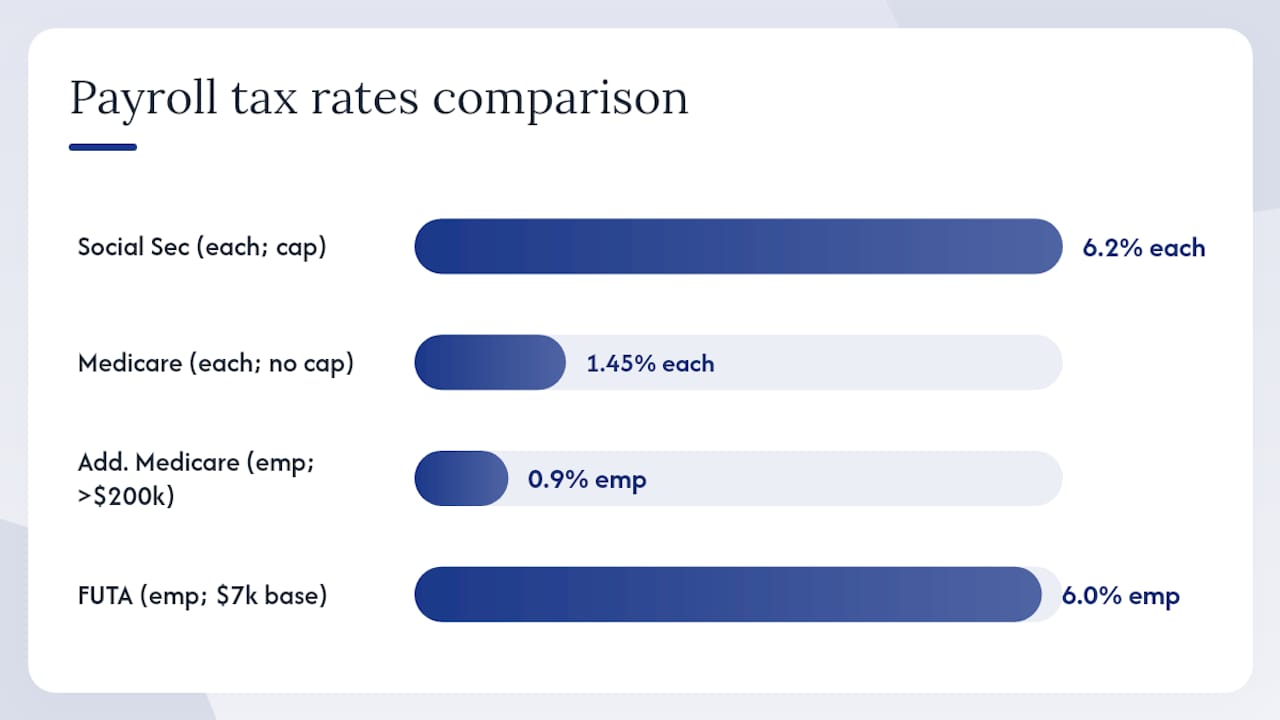
Federal income tax withholding is calculated from each employee's Form W-4 and the IRS withholding tables in Publication 15. The amount varies by filing status, allowances, and any additional withholding the employee requests.
FICA splits evenly: both you and your employee each pay 6.2% for Social Security and 1.45% for Medicare on every dollar of wages. Your share is a direct payroll expense, separate from what you withhold.
Additional Medicare Tax applies only to the employee, at 0.9% on wages exceeding $200,000 in a calendar year. You are required to begin withholding it in the pay period when cumulative wages to that employee cross the $200,000 threshold, regardless of the employee's total household income or filing status.
FUTA is employer-only. You pay it; your employees do not. Employers who pay state unemployment taxes (SUTA) on time generally receive a credit against FUTA, which reduces the effective federal rate significantly.
Statistic callout: The Additional Medicare Tax rate is 0.9%, and the withholding obligation begins the pay period wages to a single employee exceed $200,000 for the calendar year — not at year-end reconciliation.
Special categories worth noting: household employers (domestic workers) use Schedule H rather than Form 941. Agricultural employers file Form 943. Railroad employers are subject to the Railroad Retirement Tax Act rather than standard FICA rules.
Who pays employment taxes, and what are your responsibilities as an employer?
The distinction between withholding and your own tax expense matters more than most new employers realize. Withheld income tax and the employee's FICA share are funds you collect on behalf of the government. Your employer FICA match and FUTA payment come out of your own operating budget.
Your concrete obligations as an employer:
- Calculate withholdings — each pay period using IRS tables or payroll software.
Form 941 instructions detail exactly which taxes are reported on each line and confirm that withholding obligations apply each time you pay wages. The forms are not optional reporting; they are the legal mechanism through which your deposits are reconciled.
Pro Tip: Set up a dedicated bank account for payroll tax deposits. Keeping withheld funds separate from your operating cash is the single most effective way to avoid accidentally spending money that belongs to the IRS.
For a deeper look at employee self-service and W-4 collection, Glendale Payroll's guide walks through the onboarding setup step by step.
How do you calculate withholding each pay period?
Accurate withholding follows a clear sequence. Here is the standard process for a regular wage payment:
- Handle supplemental wages separately if needed. Bonuses, commissions, and overtime paid separately from regular wages can be withheld at the IRS flat supplemental rate (currently 22%) or aggregated with regular wages. Overtime wages themselves are fully taxable; for a clear breakdown of how overtime pay is treated, see this overtime taxation guide.
Simple example: An employee earns $3,000 in a biweekly pay period with no pre-tax deductions. You withhold federal income tax per their W-4, plus $186 (6.2% Social Security) and $43.50 (1.45% Medicare) from their check. You owe a matching $186 and $43.50 as your employer expense. Total FICA deposited for this employee this period: $459.
Pro Tip: Tips reported by employees are wages for FICA and income tax purposes. If your business receives tips, make sure your payroll system includes reported tip income in the withholding calculation each period.
When and how do you deposit and report employment taxes?
Depositing and reporting are two separate acts. Filing a return does not substitute for making a deposit, and the IRS treats them as distinct obligations with distinct penalty tracks.
Deposit schedules
Your deposit frequency is determined by your lookback period, which is the total employment tax liability reported in the four quarters ending June 30 of the prior year. New employers with no lookback history default to the monthly schedule. Employers who reported more than $50,000 in that period use the semiweekly schedule. IRS deposit and reporting guidance explains how to determine which schedule applies to you and the specific due dates for each.
Using the wrong schedule, even when the dollar amount is correct, triggers failure-to-deposit penalties. For a detailed breakdown of how schedules work in practice, Glendale Payroll's payroll tax deposit schedule guide is a useful reference.
How to deposit
EFTPS is the standard federal system for making employment tax deposits electronically. Most employers are required to use electronic funds transfer, and EFTPS is free to use. You schedule payments in advance and receive confirmation numbers for every transaction.
Core returns and deadlines
| Form | What It Covers | Filing Period | Typical Deadline |
|---|---|---|---|
| Form 941 | Income, Social Security, Medicare taxes | Quarterly | Last day of the month after quarter-end |
| Form 940 | FUTA | Annual | January 31 |
| Form W-2 | Employee wage and tax statement | Annual | January 31 (to employee and SSA) |
Form W-2s must be furnished to employees and filed with the Social Security Administration by January 31. The SSA's Business Services Online portal handles electronic W-2 submissions. For employers who prefer a third-party e-file option for W-2s and information returns, Tax Form Hero supports electronic filing of W-2s, 1099s, and ACA forms.
- State unemployment (SUTA) returns are filed separately with your state agency on its own schedule.
- California employers file DE 9 and DE 9C with the EDD quarterly.
- Most states require electronic deposits above certain thresholds.
What penalties do small employers face, and how do you avoid them?
The IRS penalty structure for employment taxes is steep, and the most serious penalty can reach beyond the business to individuals personally.
- Failure-to-deposit penalty: Ranges from 2% to 15% of the unpaid deposit amount, depending on how many days late the deposit is. The rate escalates quickly.
- Failure-to-file penalty: Applies when a required return (Form 941, Form 940) is not filed on time, calculated as a percentage of unpaid tax per month.
- Trust Fund Recovery Penalty (TFRP): The most serious exposure. Per Publication 15, the IRS can hold any "responsible person" personally liable for 100% of unpaid trust fund taxes. This means the penalty can attach to owners, officers, or anyone with authority over payroll funds, not just the business entity.
- Accuracy-related interest: Accrues on any underpayment from the original due date until the balance is paid.
Common root causes:
- Treating withheld taxes as available operating cash (the most frequent trigger for TFRP).
- Misclassifying employees as independent contractors, which eliminates withholding and employer FICA obligations incorrectly.
- Missing a deposit schedule change after crossing the $50,000 lookback threshold.
- Using the wrong withholding method for supplemental wages or bonuses.
Pro Tip: Automate your deposit calendar in EFTPS by scheduling deposits immediately after each payroll run rather than waiting until the due date. This removes the human error of forgetting a deposit and creates a clear audit trail.
Understanding why payroll compliance matters for your business goes beyond avoiding fines. A single TFRP assessment can threaten personal assets, not just the company's balance sheet.
What state and local employment taxes do you also owe?
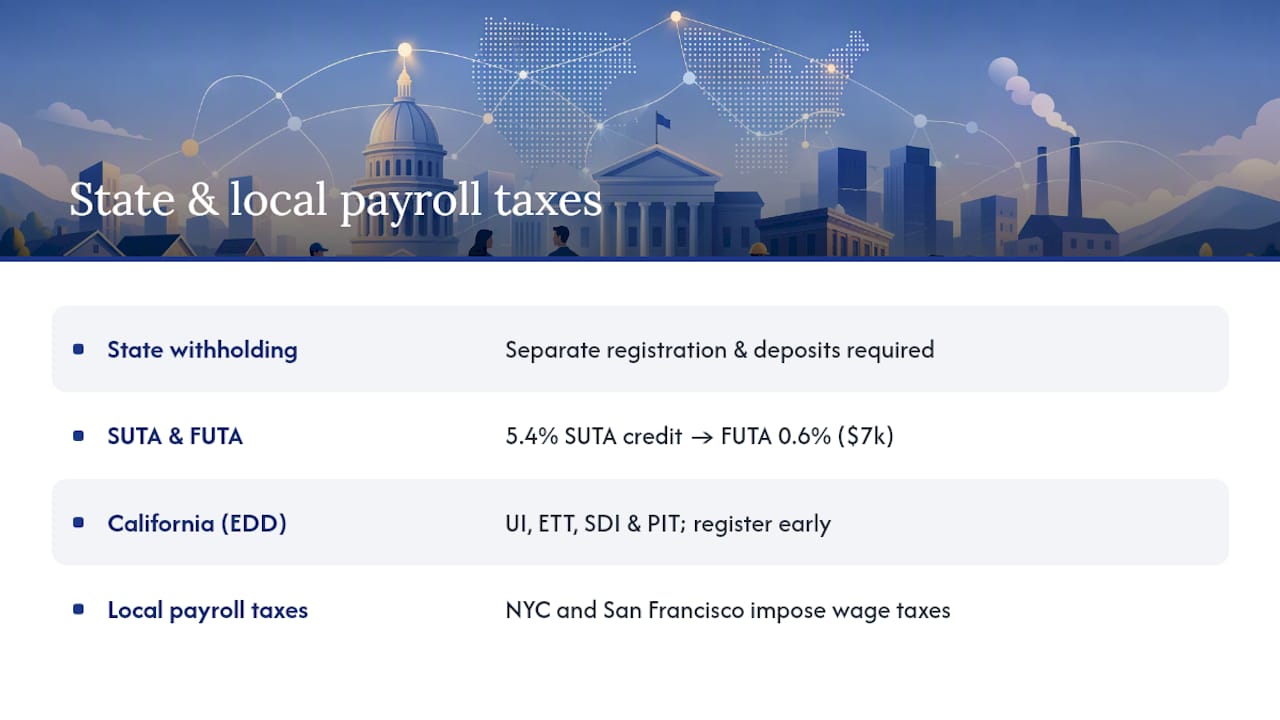
Federal employment taxes are only part of your total payroll tax obligation. Every state with an income tax requires separate withholding registration and deposits, and all states administer their own unemployment insurance programs (SUTA).
SUTA and the FUTA credit connection: Employers who pay SUTA taxes on time and in full generally qualify for a credit of up to 5.4% against the 6.0% FUTA rate, reducing the effective federal unemployment rate to 0.6% on the first $7,000 of each employee's wages. If your state loses its federal certification (a rare but real event), that credit can be reduced.
California employers face one of the more complex state payroll tax environments in the country. The California Employment Development Department (EDD) administers four separate employer and employee obligations: Unemployment Insurance (UI), Employment Training Tax (ETT), State Disability Insurance (SDI), and California Personal Income Tax (PIT) withholding. Employers must register with the EDD, often before the first payroll, and follow California-specific deposit schedules that may differ from federal timing. For a current overview of California requirements, Glendale Payroll's 2026 California payroll tax updates covers the latest changes.
Local payroll taxes (city or county) apply in some jurisdictions. New York City, San Francisco, and a number of other municipalities impose their own taxes on wages. Check with your state and local revenue agencies to confirm what applies in your location.
Your employment tax compliance checklist
Use this checklist to build a solid payroll tax foundation from day one. For startup payroll tax obligations, Glendale Payroll's guide for new businesses covers the onboarding sequence in detail.
- Get your EIN — from the IRS at irs.gov before your first payroll.
- Register with EFTPS — at eftps.gov and confirm your login credentials well before your first deposit due date.
- Issue W-2s — to employees and file with the SSA by January 31 each year.
Pro Tip: Budget for employer FICA and FUTA as a line item in your hiring cost model before you make an offer. Employer payroll taxes add roughly 7.65% to your base wage cost before any state taxes, and many small employers underestimate this when projecting cash flow.
Key Takeaways
Employment tax is a federal legal obligation that requires employers to withhold, deposit, and report taxes on every dollar of wages paid, and withheld funds are trust fund money that can trigger personal liability if mishandled.
| Point | Details |
|---|---|
| Employment tax definition | Federal taxes on wages: income withholding, FICA (Social Security and Medicare), and FUTA. |
| Fiduciary duty on withheld funds | Withheld taxes belong to the IRS, not your business; misuse can trigger the Trust Fund Recovery Penalty. |
| Additional Medicare Tax threshold | Withhold an extra 0.9% once a single employee's wages exceed $200,000 in the calendar year. |
| Three immediate risk-reduction actions | Register with EFTPS, automate deposit scheduling, and reconcile tax liabilities monthly. |
| Glendale Payroll | Handles federal and California state tax filing, EFTPS setup, and W-2 processing for employers in Greater Los Angeles. |
The compliance mindset most employers get wrong
One misconception comes up more than any other in our work with small employers: the belief that withheld payroll taxes are the company's money until the IRS asks for them. They are not. The moment you process a paycheck and withhold federal income tax or FICA, those funds have a legal owner, and it is not your business.
The practical consequence of that misunderstanding is the Trust Fund Recovery Penalty, which is the IRS's mechanism for collecting unpaid trust fund taxes directly from responsible individuals when a business cannot pay. We have seen employers who ran otherwise sound businesses face personal assessments because they used withheld funds to cover a short-term cash gap, fully intending to repay it. The IRS does not treat intent as a defense.
The good news is that the controls are not complicated. A separate payroll tax bank account, automated EFTPS deposits scheduled immediately after each payroll run, and a monthly reconciliation against Form 941 liability eliminate the vast majority of risk. The employers who struggle are almost always those who treat payroll tax as a month-end task rather than a per-payroll obligation. Routine, automated processes are the answer, not deeper knowledge of the tax code.
Glendale Payroll takes the compliance burden off your plate
For small employers in Glendale, Burbank, Pasadena, and Greater Los Angeles, managing federal and California state payroll taxes in-house means staying current with two separate regulatory frameworks, multiple deposit schedules, and year-end filing deadlines that arrive faster than expected.

Glendale Payroll handles the full cycle: federal and California state tax filing, EFTPS deposit setup and scheduling, quarterly Form 941 preparation, annual Form 940, year-end W-2 processing and SSA submission, and California EDD account registration for new employers. Every client works with a dedicated payroll professional, not a call center. The service runs on a flat monthly fee plus a per-employee rate, so your cost is predictable from day one.
The starting point is a free payroll audit. Glendale Payroll reviews your current setup, identifies deposit schedule errors, misclassification risks, and withholding gaps before they become IRS notices. If you are ready to move from DIY to a managed service, review the California payroll compliance guide or visit Glendale Payroll's services page to request your audit.
Useful sources for employers
The following official sources are the authoritative references for employment tax rules, forms, and deposit requirements:
- Understanding employment taxes | Internal Revenue Service
- Publication 15 (Circular E), Employer’s Tax Guide
- Depositing and reporting employment taxes | Internal Revenue Service
- Instructions for Form 941 (03/2026) | Internal Revenue Service
- Topic No. 560 Additional Medicare Tax
- Publication 15 | Internal Revenue Service
- Electronic Federal Tax Payment System (EFTPS)
- Social Security Administration - Business Services Online