
What is third-party payroll administration?
Third-party payroll administration is the practice of hiring an external provider to handle payroll calculations, tax withholding, and government reporting on your behalf. The IRS recognizes four distinct types of these arrangements, each carrying different levels of employer liability.
- Payroll Service Providers (PSPs): Administrative agents that prepare paychecks, file Forms 940 and 941, and make federal tax deposits using your Employer Identification Number (EIN). They assume no tax liability for your obligations.
- Reporting Agents: A specialized type of PSP authorized via Form 8655, Reporting Agent Authorization, which allows them to electronically sign and file returns on your behalf.
- Section 3504 Agents: Appointed through Form 2678, these agents agree to share liability with you for Social Security, Medicare, and federal income tax withholding. The IRS can pursue both you and the agent for unpaid taxes.
- Certified Professional Employer Organizations (CPEOs): IRS-certified entities that pay wages directly to your workers and assume responsibility for federal employment tax withholding, reporting, and payment under a formal CPEO contract.
One point that surprises many business owners: outsourcing payroll does not transfer your legal responsibility. With PSPs and Reporting Agents, you remain solely liable for all employment taxes. Only a CPEO arrangement can relieve certain tax liabilities under specific contract terms.
When does it make sense to outsource payroll?
Most small to mid-sized businesses reach a tipping point where managing payroll in-house stops making sense. Growth is usually the trigger. Once you add your tenth or fifteenth employee, the time spent on payroll calculations, tax filings, and compliance tracking starts to compete with time you need for actual business operations.
A few situations that consistently push businesses toward outsourcing payroll:
- Multi-state or multi-jurisdiction employees: Each state has its own withholding rules, unemployment tax rates, and filing deadlines. Managing these manually across even two states multiplies your compliance exposure.
- Rapid hiring: Adding employees quickly means more W-4s, more tax registrations, and more room for error in your first few payroll cycles.
- Payroll complexity: Salaried, hourly, part-time, and contractor pay all follow different rules. Add benefits deductions, garnishments, and PTO accruals, and the process becomes genuinely difficult to manage without dedicated expertise.
- Compliance pressure: Federal and state payroll tax laws change regularly. Staying current requires ongoing attention that most small business owners simply cannot spare.
Outsourcing payroll helps businesses save time, reduce errors, and maintain compliance as they grow, especially when employees work across multiple jurisdictions. The administrative relief alone is often worth the cost.

What are the real advantages of third-party payroll services?
The benefits of payroll outsourcing go well beyond saving time on Friday afternoons. Here is what businesses consistently gain:
- Error reduction: Automated payroll calculations eliminate the manual math mistakes that trigger IRS notices and employee complaints. Expert providers also catch classification errors before they become penalties.
- Compliance assurance: A qualified provider tracks federal and state tax law changes, updates withholding tables, and files returns on schedule. You get compliance without having to monitor every regulatory update yourself.
- Access to current technology: Third-party providers invest in payroll platforms that most small businesses could not justify purchasing independently. These platforms handle direct deposit, tax form generation, and year-end W-2 processing automatically.
- Data security: Payroll data includes Social Security numbers, bank account details, and salary information. Reputable providers maintain security protocols and data protection standards that exceed what most small businesses can build internally.
- Scalability: As your headcount grows, a third-party provider scales with you without requiring you to hire additional HR or accounting staff.
- HR and accounting integration: Most platforms connect directly with accounting software and HR systems, reducing duplicate data entry and improving reporting accuracy.
Payroll compliance: what you are still responsible for
This is the section most business owners underestimate. The IRS is unambiguous: you remain ultimately responsible for the deposit and payment of all federal employment taxes, even when you have hired a third party to handle them. If your provider misses a tax deposit, the IRS will pursue you, not the provider.
Your liability exposure depends on the type of arrangement you have chosen:
- PSP or Reporting Agent: You retain full liability. The provider acts on your behalf but does not share your tax obligations.
- Section 3504 Agent: Joint and several liability. Both you and the agent can be pursued for unpaid taxes.
- CPEO: Under a qualifying contract, the CPEO assumes responsibility for federal employment tax withholding, reporting, and payment on wages it pays to your workers.
Employer liability does not disappear when you outsource payroll. The IRS can assess penalties and interest directly against your business account if your provider fails to remit taxes on time, regardless of any agreement you have with that provider.
Practical steps to protect yourself:
- Register on the Electronic Federal Tax Payment System (EFTPS) and obtain your own PIN. This gives you 16 months of payment history you can verify independently.
- Confirm your provider uses EFTPS for all federal tax deposits.
- Review your EFTPS account regularly, not just at year-end.
- Authorize Reporting Agents formally using Form 8655. Verbal agreements do not establish legal authorization.
How third-party payroll services improve day-to-day operations
The operational improvements from outsourcing payroll are felt quickly. Payroll calculations that once took hours get processed automatically, with tax withholdings updated in real time as rates change. Filing deadlines for Forms 940, 941, and state equivalents are tracked and met without you building a compliance calendar from scratch.

Technology platforms automate calculations, filings, and document distribution, which means your employees get their pay stubs and W-2s on time without manual intervention from your office. Employee self-service portals let workers update their direct deposit information, view pay history, and download tax documents independently.
Integration with accounting platforms like QuickBooks or Xero eliminates the need to manually post payroll journal entries. HR system connections keep employee records consistent across platforms, reducing the risk of discrepancies between your payroll data and your HR files. For a business managing 20 to 100 employees, these integrations alone can recover several hours of administrative work each pay period.
How to choose the right third-party payroll provider
Not all providers offer the same level of compliance expertise or liability protection. Before you sign a contract, work through these criteria:
- Compliance expertise: Verify that the provider understands both federal requirements and the specific state laws that apply to your workforce. A provider strong on federal compliance but unfamiliar with your state's unemployment tax rules or wage payment laws is a liability risk.
- IRS authorization status: Confirm whether the provider operates as a PSP, Reporting Agent (Form 8655), Section 3504 Agent (Form 2678), or CPEO. Each carries different liability implications for your business.
- Technology platform: Assess whether their system integrates with your accounting and HR software, supports direct deposit, and provides employee self-service access.
- Data security: Ask specifically about their data encryption standards, access controls, and breach notification procedures. Payroll data is among the most sensitive information your business holds.
- Pricing transparency: Understand exactly what is included in the base fee and what triggers additional charges. Per-employee fees, year-end W-2 processing, and state filing fees are common add-ons that can significantly affect your total cost.
- Client support: Determine whether you will have a dedicated contact or be routed through a general support queue. For compliance-sensitive questions, direct access to a knowledgeable professional matters.
- Reputation and references: Check for IRS enforcement actions, client reviews, and any history of missed tax deposits. A single missed deposit is a serious warning sign, per IRS guidance on provider selection.
Pro Tip: Before finalizing any provider agreement, ask specifically whether they will use EFTPS for your federal tax deposits and whether you can verify those payments independently using your own EFTPS PIN. Any provider that discourages this level of oversight is a red flag.
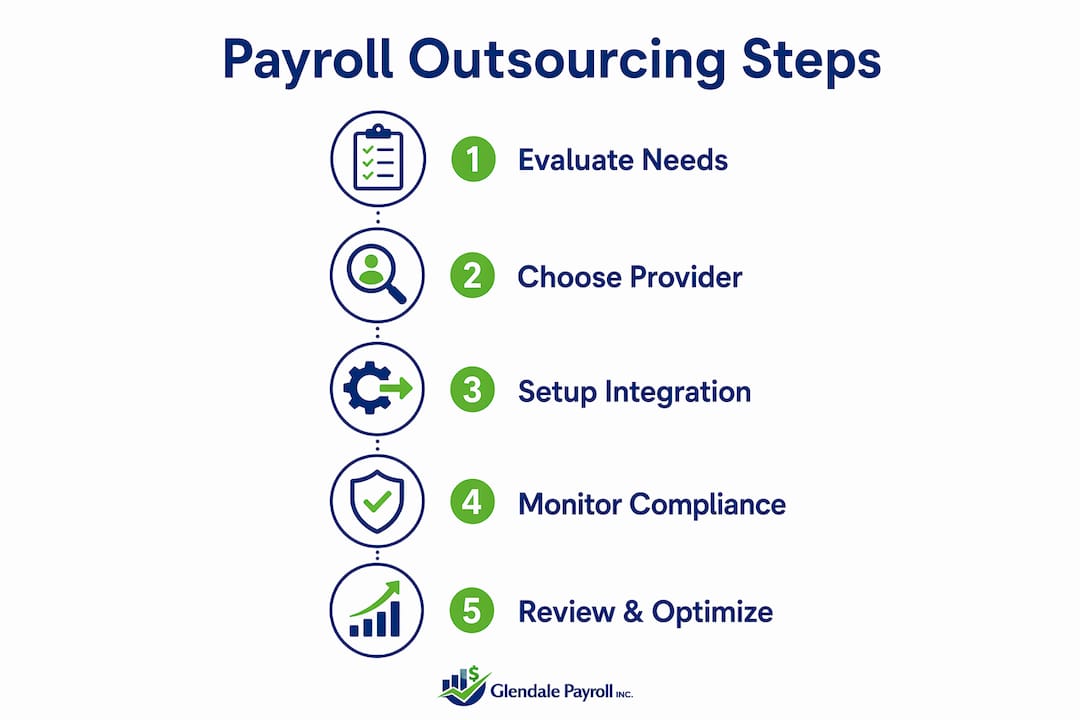
How Glendale Payroll supports California businesses with compliance
California payroll compliance is genuinely more complex than federal requirements alone. The state imposes its own State Disability Insurance (SDI) contributions, Employment Training Tax (ETT), and Unemployment Insurance (UI) obligations, each with their own rate schedules and filing deadlines. Add California's strict wage and hour laws, including specific rules on overtime, meal breaks, and final pay timing, and the compliance burden on a small business in Glendale, Burbank, or Pasadena is substantial.
Glendale Payroll addresses this directly. Rather than routing your questions through a call center, the firm assigns dedicated payroll professionals who understand both federal IRS requirements and California-specific obligations. Their process starts with a free comprehensive payroll audit to identify existing compliance gaps before they become penalties. For businesses that have been managing payroll in-house or with a generalist provider, this audit frequently surfaces issues with worker classification, tax deposit timing, or state filing accuracy.
For California businesses specifically, Glendale Payroll's team monitors updates to the UI Tax Rate Schedule, SDI contribution rates, and changes to the ABC test for independent contractor classification. These are not static rules. They shift regularly, and missing an update can result in back taxes, penalties, and interest. You can find California-specific payroll guidance covering current compliance requirements and best practices for Los Angeles-area businesses.
Pro Tip: Even when working with a trusted provider like Glendale Payroll, register on EFTPS and verify your federal tax deposits independently at least once per quarter. This takes less than five minutes and gives you documented proof that your obligations are being met on time.
For businesses that want to understand the full scope of payroll tax planning alongside outsourcing, Glendale Payroll's team can walk you through both federal and state obligations in a single compliance review.
Potential risks and drawbacks of using third-party payroll services
Outsourcing payroll reduces your workload, but it introduces risks you need to manage actively.
- Retained liability: As covered above, you remain legally responsible for all tax payments. If your provider steals funds intended for tax deposits, the IRS will still hold you accountable. The IRS has prosecuted individuals and companies operating under the appearance of payroll service providers who diverted employer tax funds.
- Loss of direct control: When payroll runs through a third party, you depend on their systems and processes. An outage, a data error, or a staffing change at the provider can delay your employees' pay.
- Data breach exposure: Centralizing sensitive employee data with an external provider creates a concentrated target. A breach at the provider level can expose your entire workforce's financial and personal information.
- Hidden costs: Base fees often exclude state filings, year-end processing, and off-cycle payroll runs. Without careful review of the contract, your actual annual cost can exceed your initial estimate.
- Compliance gaps in specialized areas: A generalist provider may not stay current on California-specific rules, multi-state tax obligations, or industry-specific requirements like prevailing wage laws. This is where choosing a provider with genuine local expertise, rather than a national call center operation, makes a practical difference.
- Transition risk: Switching providers mid-year creates gaps in payroll records and increases the chance of duplicate or missed filings. Timing a transition carefully, ideally at the start of a new calendar year, reduces this risk.
What does third-party payroll administration cost?
Pricing for third-party payroll services varies by provider type, employee count, and the scope of services included. Most providers use one of two models or a combination of both.
Per-employee, per-pay-period pricing is the most common structure for small to mid-sized businesses. You pay a base fee plus a per-employee charge each time payroll runs. As your headcount grows, this model scales predictably, though the per-employee rate often decreases at higher volumes.
Flat monthly fee pricing bundles a defined set of services for a fixed monthly cost. This works well when your payroll is consistent in size and complexity, but add-ons for state filings, W-2 processing, or garnishment administration can erode the simplicity of the flat fee.
Outsourcing payroll tends to become more cost-effective relative to in-house management as employee counts increase and payroll complexity grows. For a business running bi-weekly payroll for 25 employees across two states, the cost of a qualified external provider typically compares favorably to the combined expense of staff time, payroll software licenses, and the risk of penalty exposure from errors.
Additional cost factors to evaluate:
- Year-end W-2 and 1099 processing fees
- State and local tax filing fees beyond the base service
- Off-cycle payroll run charges
- Setup and onboarding fees
- Fees for HR integrations or employee self-service portals
Always request a full fee schedule before signing, and ask specifically which services trigger additional charges. Transparency in pricing is itself a signal of a provider's overall reliability.
Real-world scenarios: how small businesses use third-party payroll
These scenarios reflect common patterns among small to mid-sized US businesses that have moved to third-party payroll administration.
A 12-person restaurant in Pasadena was managing payroll manually with a spreadsheet and a bookkeeper who handled taxes quarterly. After a state audit revealed missed SDI deposits and incorrect overtime calculations, the owner switched to a dedicated payroll provider. The provider corrected the classification errors, set up automated bi-weekly payroll, and handled all state filings going forward. The owner's bookkeeper shifted focus to accounts payable and financial reporting.
A 35-person tech services firm in Burbank expanded into Nevada and Texas within 18 months. Managing three state tax registrations, different unemployment tax rates, and varying new-hire reporting requirements in-house quickly exceeded the capacity of their two-person HR team. A third-party provider with multi-state expertise took over all payroll processing, freeing the HR team to focus on recruiting and benefits administration.
A 7-person medical practice in Glendale had been using a national payroll platform but found that compliance questions went unanswered or were handled by rotating support staff unfamiliar with California's specific requirements. Switching to a local provider with dedicated professionals meant that questions about California's final pay rules and SDI rates got accurate answers quickly, rather than generic responses from a call center. For businesses in similar situations, reviewing why companies switch payroll providers can help clarify whether a change is warranted.
These scenarios share a common thread: the businesses that benefit most from outsourcing are those where payroll complexity has outpaced their internal capacity to manage it accurately.
Work with Glendale Payroll to protect your business
If you are managing payroll for a small to mid-sized business in California, the compliance stakes are higher than in most other states. Glendale Payroll's team of dedicated payroll professionals, not call center generalists, handles federal and California-specific obligations with the precision your business requires. Start with a free payroll audit to identify your current risk exposure, then let the team build a compliant, accurate payroll process around your specific needs.
Businesses across Glendale, Burbank, Pasadena, and Greater Los Angeles trust Glendale Payroll to keep them current with IRS requirements and California law. For a full overview of available payroll compliance services, or to review current California tax requirements, visit the California compliance guide. You can also explore tax and payroll resources from The Gap ProAdvisors for additional perspective on compliance planning.
Key Takeaways
Third-party payroll administration reduces compliance risk and administrative burden, but employers remain legally liable for all employment taxes regardless of which provider they use.
| Point | Details |
|---|---|
| Employer liability persists | The IRS pursues the employer for unpaid taxes even when a third-party provider misses deposits. |
| Provider types carry different risks | PSPs assume no liability; CPEOs can relieve certain tax obligations under a qualifying contract. |
| EFTPS verification is essential | Register on EFTPS and verify your federal tax deposits independently, at least quarterly. |
| Form 8655 and Form 2678 define authority | These IRS forms legally authorize Reporting Agents and Section 3504 Agents to act on your behalf. |
| California adds compliance complexity | State-specific SDI, UI, and wage and hour rules require a provider with genuine California expertise. |
Recommended
- Payroll Tips for California Small Businesses | Glendale Payroll Inc.
- Employee Self-Service Payroll Setup: A 2026 Guide | Glendale Payroll Inc.
- Payroll Process Review: A Guide for Small Business | Glendale Payroll Inc.
- Payroll Date Management: A 2026 Guide for Small Businesses | Glendale Payroll Inc.