
California misclassification penalties are severe because the state stacks civil fines, payroll-tax liabilities, and private-attorney enforcement across multiple agencies simultaneously, creating exposure that can reach six figures even for a small employer with just a handful of workers. No other state combines the ABC test's strict classification standard, Labor Code §226.8 civil penalties, and the Private Attorneys General Act (PAGA) into a single enforcement environment, the way California does.
The primary drivers of that severity:
- ABC test (AB5-era standard): A worker is presumed an employee unless the employer proves all three prongs. Failing even one prong means misclassification.
- Labor Code §226.8 civil penalties: $5,000–$15,000 per violation; $10,000–$25,000 per violation for a pattern or practice of willful misclassification.
- PAGA penalties: $100 per aggrieved employee per pay period for initial violations; $200 for subsequent violations, split 75/25 between the state and the worker.
- EDD payroll-tax liabilities: Back UI, ETT, and SDI contributions, plus interest and potential fraud penalties.
- Federal IRS/DOL exposure: Unpaid employment taxes, liquidated damages under the FLSA, and possible Form 8919 reporting consequences.
Your first move: run a classification audit before any agency does it for you.
Key Takeaways
California misclassification penalties are severe because the ABC test, Labor Code §226.8, PAGA, and multi-agency enforcement combine to stack civil fines, payroll-tax liabilities, and private litigation exposure simultaneously.
| Point | Details |
|---|---|
| ABC test raises the bar | All three prongs must be met; failing even one means misclassification regardless of contract language. |
| Penalties stack fast | §226.8 fines ($5,000–$25,000 per worker), PAGA ($100–$200 per pay period), and EDD back taxes combine to reach six figures for small employer groups. |
| Multi-agency enforcement multiplies risk | A single EDD audit can trigger IRS and DLSE follow-ups through information-sharing agreements. |
| Voluntary correction reduces exposure | The IRS VCSP limits federal tax liability; acting before any agency contact removes the willfulness risk under §226.8. |
| Glendale Payroll | Offers free classification audits and ongoing compliance support for employers in Glendale, Burbank, Pasadena, and Greater Los Angeles. |
Table of Contents
- Why California's ABC test makes misclassification penalties so severe
- What penalties California employers can actually face
- How penalties grow: three worked scenarios
- Which agencies enforce misclassification and how investigations start
- 1. Worker performs work in the company's usual course of business
- 2. Company controls schedule, tools, or supervision
- 3. Worker is paid by the hour or on a payroll-like schedule
- 4. Worker lacks an independently established business
- 5. Signed contractor agreements that don't match actual practice
- 6. Prior audit warnings or internal cost-saving discussions
- Practical steps to reduce your misclassification exposure now
- What a payroll compliance audit actually finds and fixes
- Real enforcement outcomes that show why the stakes are high
- How long the enforcement process takes from start to resolution
- The full cost picture, including indirect costs
- What California employers consistently get wrong about misclassification
- Glendale Payroll helps you avoid misclassification penalties before they start
- Sources
Why California's ABC test makes misclassification penalties so severe
California uses the ABC test, codified through AB5, to determine whether a worker is an employee or an independent contractor. The test places the burden squarely on the employer to prove all three prongs:
- Prong A: The worker is free from the company's control and direction in performing the work, both under the contract and in practice.
- Prong B: The worker performs work outside the usual course of the company's business.
- Prong C: The worker is customarily engaged in an independently established trade, occupation, or business of the same nature as the work performed.
Prong B is where most employers stumble. If your business is a marketing agency and you hire a "freelance" graphic designer who works exclusively for you, that worker almost certainly fails prong B. The label on the contract is irrelevant.
The California DIR/DLSE is explicit: calling a worker an independent contractor has no legal weight. Agencies examine the actual working relationship and the control exercised over how, when, and where work is performed.
"Willful misclassification" under Labor Code §226.8 means the employer voluntarily and knowingly avoided classifying the worker as an employee. That standard matters because it converts a compliance error into a maximum-penalty event. Internal emails discussing cost savings from using contractors, prior audit warnings, or a history of reclassification findings can all serve as evidence of willfulness.
Signed contractor agreements, invoices, and "1099 arrangements" do not shield you. California courts and agencies look at behavior: who sets the schedule, who provides tools, who controls the work product. A California employee classification review must examine actual practice, not paperwork.
What penalties California employers can actually face
The exposure stacks across multiple statutory sources. Here is every major penalty line item:
The California EDD can assess UI, ETT, and SDI contributions the employer failed to withhold, plus interest on the unpaid balance. The U.S. Department of Labor adds a separate layer: under the FLSA, workers denied minimum wage or overtime may recover liquidated damages equal to the unpaid amount, effectively doubling the wage liability.
Beyond the statutory fines:
- Reputational damage from public §226.8 findings (the DLSE can require posting of violation notices)
- Higher workers' compensation insurance premiums after reclassification
- Operational disruption from retroactive payroll corrections and system overhauls
- Increased audit scrutiny from multiple agencies for years after a finding
PAGA acts as a force multiplier: penalties stack per pay period and can generate separate penalty streams for related violations such as wage-statement errors and missed meal or rest breaks.
How penalties grow: three worked scenarios
These scenarios use illustrative inputs to show how costs compound. They are not legal advice; actual exposure depends on specific facts.
Scenario 1: One misclassified worker, one year
- 1 worker, $25/hour, 45 hours/week average, 52 weeks
- Unpaid overtime (5 hrs/week × 52 × $12.50 premium): ~$3,250
- PAGA initial penalty (over 26 pay periods at $100 each): a substantial amount
- §226.8 civil penalty (1 worker, non-pattern): a significant fine within a defined range
- EDD back taxes (estimated UI/ETT/SDI on approximately $58,500 wages): a moderate sum
- Estimated total: a range of penalties and back taxes reaching into the tens of thousands of dollars
Scenario 2: Five workers, two years
- 5 workers, same pay rate, 104 pay periods
- Unpaid overtime (5 workers over 2 years): a substantial amount
- PAGA (5 workers over multiple periods with initial and subsequent penalties): a significant total
- §226.8 civil penalties (5 workers at mid-range penalty): a large sum
- EDD back taxes (5 workers over 2 years): a considerable amount
- Attorney fees (conservative estimate): substantial legal costs
- Estimated total: a broad range exceeding one hundred thousand dollars
Scenario 3: Ten workers, three years, pattern/practice finding
- §226.8 pattern/practice penalties (10 workers applying the top penalty tier): a very large penalty total
- PAGA (10 workers over many pay periods with blended penalties): a significant cumulative amount
- Unpaid overtime plus liquidated damages (FLSA): a considerable sum
- EDD and IRS back taxes plus accrued interest: a substantial financial liability
- Attorney fees: high legal costs within a wide range
- Estimated total: a broad range approaching or exceeding several hundred thousand dollars
| Scenario | Workers | Duration | Est. Total Exposure |
|---|---|---|---|
| Small | 1 | 1 year | Estimated penalties and costs in the low tens of thousands |
| Medium | 5 | 2 years | Estimated penalties and costs exceeding one hundred thousand dollars |
| Large (pattern/practice) | 10 | 3 years | Estimated penalties and costs reaching several hundred thousand dollars |
Pro Tip: The fastest lever to reduce peak exposure is voluntary correction before any agency contact. The IRS Voluntary Classification Settlement Program (VCSP) lets qualifying employers pay a fraction of unpaid federal employment taxes and avoid penalties and interest for prior years. The VCSP covers federal liability only — it does not address California EDD, §226.8, or PAGA exposure.
Which agencies enforce misclassification and how investigations start
Four enforcement actors can pursue your business, often simultaneously:
- DLSE/Labor Commissioner: Handles wage claims, overtime, waiting-time penalties, and §226.8 civil penalties. Cases typically start with a worker complaint.
- EDD: Audits payroll-tax compliance and assesses back UI, ETT, and SDI. EDD audits commonly trigger IRS and DLSE follow-ups through information-sharing agreements.
- DOL/Wage and Hour Division: Pursues FLSA minimum-wage and overtime violations. Federal investigations can run parallel to state proceedings.
- IRS: Assesses unpaid federal employment taxes. Employers who failed to withhold may face Form 8919 consequences and trust-fund recovery penalties.
- Private litigants under PAGA: Any aggrieved employee can file a PAGA action on behalf of the state without a government agency initiating the case.
The most common investigation triggers:
- A worker files an unemployment claim after a project ends, prompting an EDD audit
- A wage-and-hour lawsuit names the employer, which the DLSE then investigates
- An IRS notice about unreported wages or missing W-2s
- A joint audit initiated under California's 2025 misclassification enforcement coordination between DIR, EDD, and DOL
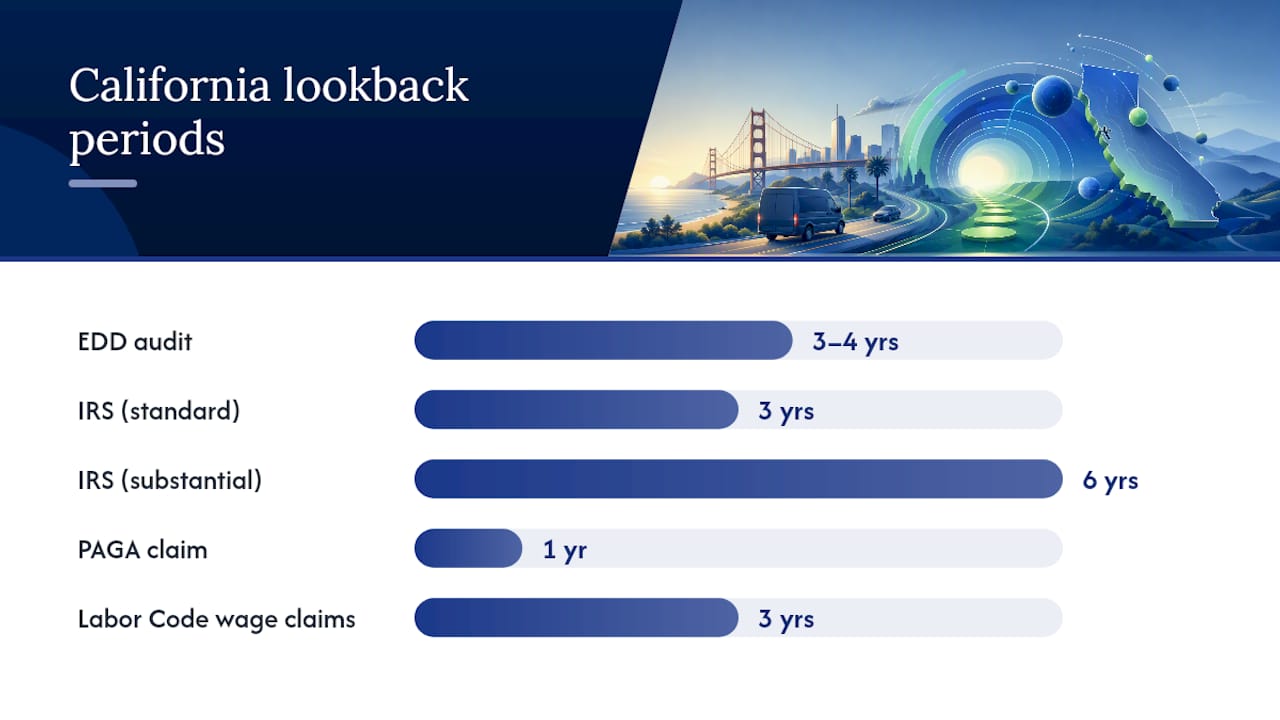
Lookback periods matter. EDD can typically audit three to four years of payroll records; the IRS can go back three years for standard assessments and six years for substantial understatements. PAGA claims are subject to a one-year statute of limitations, but wage claims under the Labor Code can reach back three years. Interest compounds throughout that entire period on any unpaid tax balance.
Pro Tip: Review your California payroll tax updates annually. Rate changes to UI, ETT, and SDI affect the back-tax calculation in any reclassification audit.
1. Worker performs work in the company's usual course of business
This is the single most common reason employers fail the ABC test. If a staffing firm hires "independent" recruiters, or a construction company uses "contractor" laborers on its own job sites, prong B fails immediately. No contract language fixes it.
2. Company controls schedule, tools, or supervision
Directing when and how work is performed signals an employment relationship. Providing equipment, requiring attendance at meetings, or assigning a supervisor all point toward employee status under prong A.
3. Worker is paid by the hour or on a payroll-like schedule
Hourly pay, regular weekly payments, or reimbursement structures that mirror payroll are red flags. Genuine contractors typically invoice for project deliverables, not time.
4. Worker lacks an independently established business
If the worker has no other clients, no business license, and no separate business entity, prong C likely fails. A worker who works exclusively for one company rarely qualifies as an independent contractor under California law.
5. Signed contractor agreements that don't match actual practice
Employers often assume a well-drafted independent-contractor agreement protects them. It does not. The DLSE guidance is clear: the actual working relationship controls, not the label on the contract.
6. Prior audit warnings or internal cost-saving discussions
If your company received a prior reclassification notice, an EDD audit letter, or internal communications show workers were classified as contractors specifically to avoid payroll taxes, those records can establish willfulness under §226.8 and trigger maximum penalties.
Pro Tip: During recruiting and onboarding, watch for these cues: a new hire asks about benefits, you set their hours, or you provide their primary tools. Any one of these should trigger a classification review before the first paycheck is issued.
Practical steps to reduce your misclassification exposure now
A structured response reduces both the probability of a finding and the severity of penalties if one occurs.
- Run a classification audit. Review every worker relationship against all three ABC test prongs. Document your analysis for each role. See the payroll process review guide for a structured starting point.
- Fix written agreements and actual work practices together. Updating a contract without changing how you supervise, schedule, or pay the worker accomplishes nothing under California law.
- Update onboarding checklists. Add a classification decision step before any new engagement begins, with a documented rationale.
- Correct payroll records proactively. If you identify a misclassified worker, begin withholding and remitting payroll taxes immediately. Retroactive corrections are harder but still reduce ongoing exposure.
- Use voluntary correction programs where available. The IRS VCSP covers federal employment taxes only. California does not have a formal equivalent, but proactive disclosure to the EDD before an audit can sometimes reduce penalties.
- Consult employment counsel for willful-exposure risk. If prior warnings exist, involve an attorney before contacting any agency. Self-disclosure without legal guidance can inadvertently confirm willfulness.
- Prepare for EDD audit readiness. Use the EDD audit preparation checklist to organize payroll records, contracts, and worker communications before any agency contact.
Pro Tip: Preserve every classification decision record: the date, the decision-maker, the prong-by-prong analysis, and any legal or HR review. If a finding later occurs, documented good-faith analysis is your strongest argument against a willfulness finding.
What a payroll compliance audit actually finds and fixes
The gig economy's growth has made misclassification a top enforcement priority. With tens of millions of Americans working independently, California agencies have increased audit resources and inter-agency coordination accordingly.
The most common audit findings that lead to reclassification:
- Workers paid hourly with no project-based invoicing structure
- Job descriptions that overlap with core business functions (prong B failure)
- Missing overtime records for workers who regularly exceeded 8 hours per day
- Contractor agreements that grant the company control over work methods
A thorough audit should review: all contractor agreements and job descriptions, pay records and time logs, workers' compensation insurance reports, worker communications and supervision records, and any prior agency correspondence.
Deliverables from a well-run audit include a risk register ranked by penalty exposure, recommended fixes for each at-risk relationship, and a documentation package that supports a good-faith defense. Gather these records first to speed any future defense or voluntary correction: the original contractor agreement, all invoices or payment records, any written communications about work scope or schedule, and any prior agency notices.
Real enforcement outcomes that show why the stakes are high
California's enforcement record makes the penalty math concrete. The DIR's 2025 misclassification enforcement update highlighted coordinated actions between DIR, EDD, and DOL targeting industries with high contractor usage, including construction, logistics, and gig-platform services. Multi-agency coordination means a single complaint can produce simultaneous wage claims, payroll-tax assessments, and PAGA litigation.
The practical analysis of AB5 and PAGA shows that six-figure exposure is common for small employer groups once PAGA penalties, §226.8 fines, and back wages combine. For larger employers or those with pattern/practice findings, total settlements have reached into the millions. These are not outlier results — they reflect the ordinary operation of California's stacked penalty system.
How long the enforcement process takes from start to resolution
Understanding the timeline helps you plan your response and manage cash-flow risk.
Month 1–3: A worker complaint, unemployment claim, or EDD audit notice arrives. The agency requests payroll records, contracts, and worker communications. You have a limited window to respond before the agency draws its own conclusions.
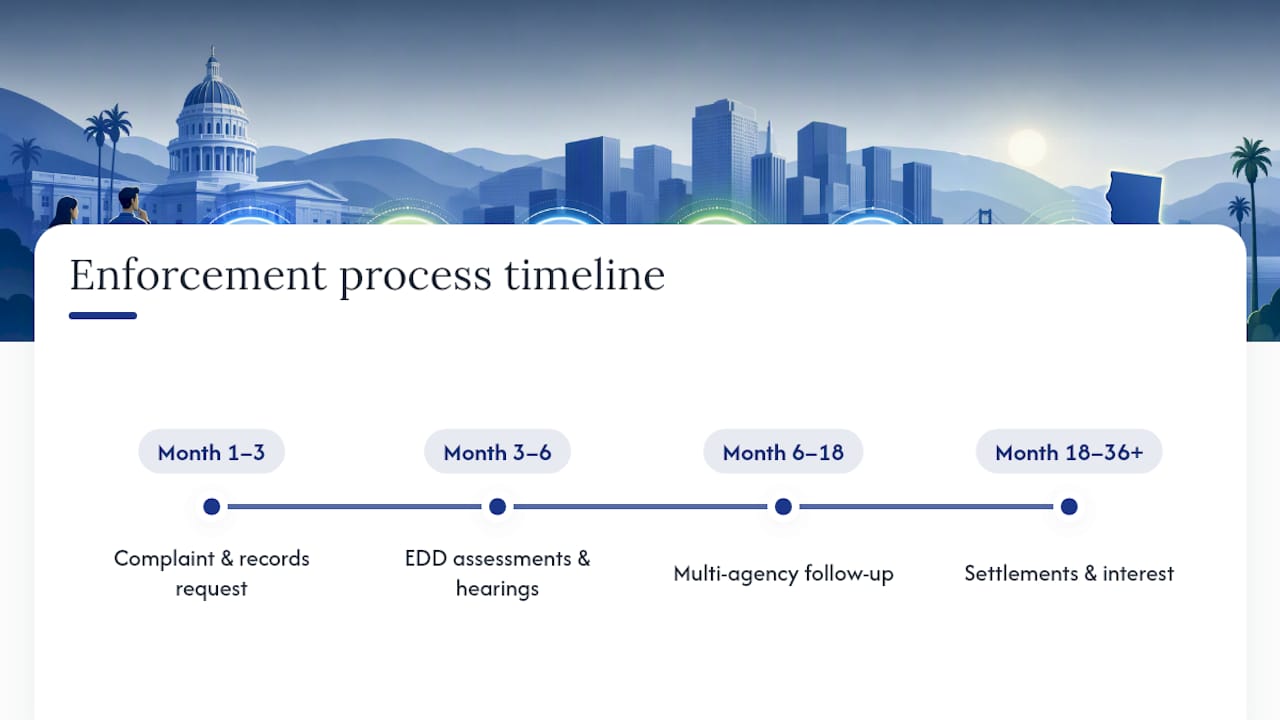
Month 3–6: The investigating agency completes its initial review. EDD issues a Notice of Assessment for back taxes. The DLSE schedules a hearing on wage claims. A PAGA plaintiff files a notice with the Labor and Workforce Development Agency (LWDA), triggering a 65-day cure window under recent PAGA reforms.
Month 6–18: Multi-agency follow-up begins. IRS issues its own assessment if EDD shares findings. DLSE issues a citation under §226.8. PAGA litigation proceeds if the LWDA does not take the case.
Month 18–36+: Settlement negotiations, administrative hearings, or civil litigation. Attorney fees accumulate throughout. Interest on unpaid EDD and IRS balances compounds daily.
The total timeline from initial complaint to final resolution typically runs 18 months to three years for contested cases. Voluntary correction before month one compresses that timeline significantly and removes the willfulness risk entirely.
The full cost picture, including indirect costs
The statutory penalties in the table above are only the direct costs. The indirect costs often match or exceed them.
Reputational damage is concrete under California law. A §226.8 finding can require the employer to post a notice of violation at the worksite and on the company website for one year. That public record affects client relationships, recruiting, and vendor contracts.
Insurance premium increases follow reclassification. Workers' compensation carriers reprice policies when payroll is restated to include formerly excluded contractors. The premium adjustment applies retroactively to the audit period and prospectively to future renewals.
Operational disruption is the cost most HR teams underestimate. Retroactive payroll corrections require system changes, amended tax filings, reissued W-2s, and updated benefits enrollment. For a company with 10 reclassified workers over three years, that administrative burden can consume hundreds of staff hours.
Financing costs arise when penalty payments are not budgeted. Employers who must borrow to pay a large EDD or IRS assessment add interest expense on top of the penalty itself.
That adjustment is not speculative — it reflects the actual experience of employers who have gone through the process.
What California employers consistently get wrong about misclassification
The most persistent mistake is treating a signed contractor agreement as a compliance solution. Employers invest in contract drafting and then continue to supervise, schedule, and direct the worker exactly as they would an employee. The contract provides no protection because California law ignores it.
The second mistake is waiting. Employers who discover a classification problem often delay action because correction feels complicated or expensive. In practice, the cost of voluntary correction is almost always lower than the cost of an agency-initiated audit. The PAGA cure window, the IRS VCSP, and proactive EDD disclosure all reduce exposure materially — but only if you act before the agency does.
The third mistake is treating misclassification as a payroll-only problem. It is a legal, tax, insurance, and operational problem simultaneously. Fixing it requires coordinated action across HR, payroll, finance, and legal — not just a contract revision.
Glendale Payroll helps you avoid misclassification penalties before they start
Misclassification exposure in California is not theoretical. The penalty math is real, the agencies are coordinated, and the timeline from complaint to resolution is long. Glendale Payroll gives California employers a concrete alternative to discovering these problems during an audit.

Glendale Payroll's California compliance services include payroll processing, federal and state payroll-tax filing, EDD employer account setup, new hire reporting, and classification compliance audits — all handled by dedicated payroll professionals, not a call center. The free payroll audit identifies your highest-risk worker relationships and produces a prioritized remediation plan before any agency contact. Employers across Glendale, Burbank, Pasadena, and Greater Los Angeles use Glendale Payroll to maintain accurate records, reduce audit triggers, and document classification decisions that support a good-faith defense. Request your free audit at Glendalepayroll or review the EDD audit preparation checklist to assess your current readiness.
Sources
Use these primary sources to verify statutory text, agency guidance, and voluntary correction procedures:
- California DIR — DLSE FAQ: Independent contractor
- California Labor Code §226.8 (statutory text)
- California Employment Development Department — Misclassified workers
- U.S. Department of Labor — Misclassification guidance (FLSA)
- IRS — Voluntary Classification Settlement Program (VCSP)
This article provides general information about California labor and payroll law. It is not legal advice. Confirm current rules and penalty amounts with the relevant agency or a qualified employment attorney before making classification decisions.
This article is general information, not a substitute for advice from a qualified lawyer. Consult a qualified legal professional about your own circumstances before acting on anything here.