
Switching payroll providers is defined as the process of migrating payroll operations, data, and compliance responsibilities from one vendor to another. Companies make this change when their current system creates recurring errors, compliance exposure, or hidden labor costs that exceed the cost of migration. Recurring payroll errors, compliance risks, and high costs are the five most cited triggers for changing payroll services. Glendale Payroll works with businesses across Greater Los Angeles that reach this decision after months of absorbing preventable losses. Understanding why companies switch payroll providers starts with recognizing that the problem is rarely just the software.
Why companies switch payroll providers: operational challenges and risks
The most common trigger for changing payroll services is a pattern of recurring payroll inaccuracies. Employees paid late, incorrect deductions, or missed overtime calculations erode trust quickly. Once payroll integrity breaks down, it takes significant time and management attention to rebuild it.
Compliance exposure is the second major driver. Multi-state payroll, California SDI calculations, UI Tax Rate Schedule updates, and ABC test classifications create a web of obligations that basic platforms often mishandle. A single misclassification or late deposit can trigger IRS penalties that far exceed the cost of a better provider.

Governance failures are the third trigger, and the least visible. Dependence on tribal knowledge is a specific risk: when only one person in your organization understands how payroll runs because of manual workarounds, the business faces unacceptable operational fragility. That person leaving or falling ill can halt payroll entirely.
Signs that operational risk has reached a critical level include:
- Payroll corrections or off-cycle runs happening more than once per quarter
- No clear audit trail for approvals or exception handling
- Compliance filings submitted late or requiring amendment
- Inability to produce payroll records quickly for an audit
- Employee self-service features missing or broken, forcing HR to handle routine requests manually
Pro Tip: Document every payroll error and correction for 90 days before evaluating a switch. That log becomes your business case and your migration checklist.
How do integration issues and hidden labor costs influence the decision to switch?
Subscription fees are the visible cost of a payroll provider. The real cost includes every hour your team spends correcting exports, re-entering data into your accounting system, and reconciling benefits deductions that did not sync correctly. Manual reconciliation and duplicate data entry can push the true cost of a "cheaper" provider well above that of a more capable one.
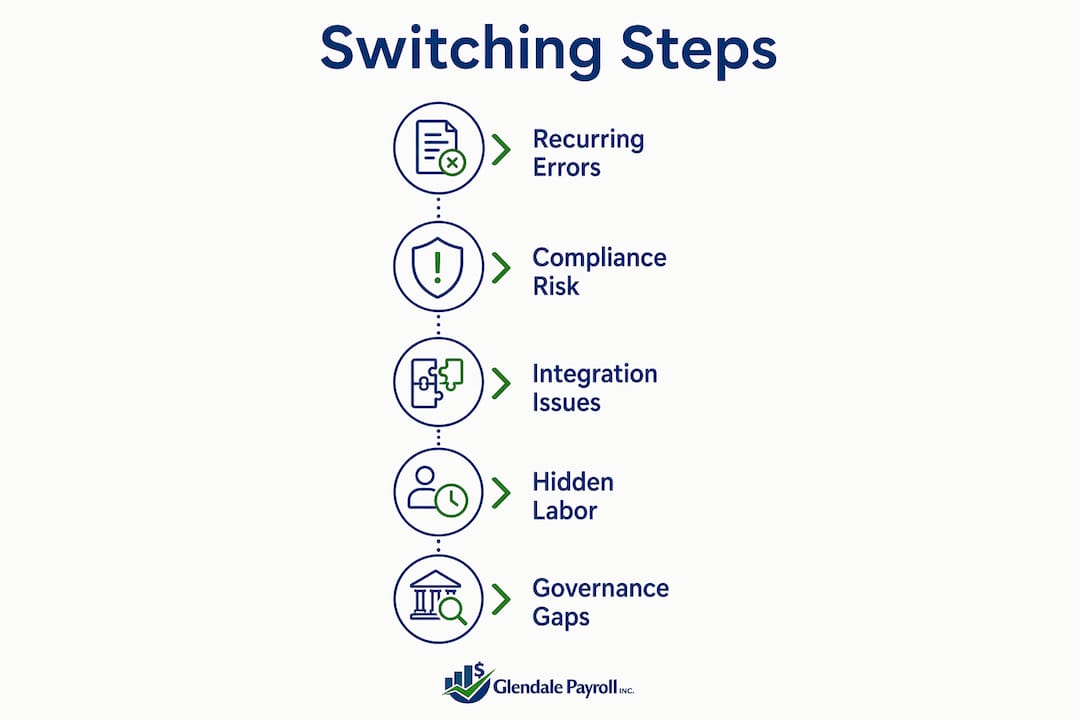
Poor integration between payroll, HR, and accounting systems creates what practitioners call reconciliation debt. Each pay cycle adds a small amount of unresolved discrepancy. Over a year, that debt compounds into a significant audit risk and a drain on your HR team's capacity.
The hidden labor costs that most business owners underestimate include:
- Time spent manually exporting and importing files between payroll and accounting platforms
- Hours correcting benefits deductions that did not carry over from open enrollment
- Management time reviewing and approving corrections that a better system would prevent
- IT or vendor support calls to patch integration failures
Calculating total payroll cost requires quantifying these hidden labor hours, not just comparing monthly fees. A provider that costs $200 more per month but eliminates 10 hours of manual reconciliation is the better financial decision for most small businesses. Payroll automation directly addresses this math by removing the manual steps that generate hidden costs.
What are the common timing considerations and practical steps for switching smoothly?
Timing a payroll provider switch correctly reduces compliance risk and simplifies the transition. Switching at the start of a calendar year or fiscal quarter minimizes tax filing complications. A year-end switch allows clean W-2 and 1099 closing with your old provider. A quarterly switch reduces mid-year reporting complexity.
Payroll transitions typically take 2–12 weeks depending on business complexity. A company with fewer than 20 employees in a single state can often complete the move in two to three weeks. A multi-entity business with employees in California, Nevada, and Texas should budget 60–90 days.
The practical steps for switching payroll providers smoothly follow this sequence:
- Conduct a data audit. List all active employees, pay rates, deductions, garnishments, and year-to-date figures before you begin.
- Request all historical data. Secure historical payroll records before closing your old account. Once access is terminated, retrieval may require fees or become impossible.
- Run parallel payroll. Process one or two pay cycles on both the old and new systems simultaneously. Parallel test runs catch data misconfigurations before they affect employees.
- Communicate with employees early. Notify employees at least two full pay cycles before the switch. Cover login changes, pay stub format differences, and any shift in payout timing.
- Confirm compliance setup. Verify that state tax IDs, SDI rates, and UI Tax Rate Schedule entries are correctly configured in the new system before the first live run.
| Step | Timing | Risk if skipped |
|---|---|---|
| Data audit | 4–6 weeks before cutover | Incomplete records, missed deductions |
| Historical data request | Before contract termination | Lost audit trail, compliance gaps |
| Parallel test run | 1–2 cycles before go-live | Undetected misconfigurations |
| Employee communication | 2 full pay cycles in advance | Confusion, morale damage |
| Compliance configuration check | Before first live run | Tax filing errors, IRS penalties |
Pro Tip: Assign one internal owner to the migration project. Distributed ownership is the most common reason transitions run over schedule.
How to distinguish between software limitations and internal process issues
Not every payroll problem is the provider's fault. Before committing to a switch, you need to determine whether the root cause is the platform or your internal processes. Switching providers without fixing internal issues produces the same problems on a new system.
Ask these questions to identify the true source of your payroll pain:
- Do errors trace back to inconsistent data submitted by managers, or to the system miscalculating correct data?
- Does your team have a documented approval process for exceptions, or does each pay cycle rely on informal decisions?
- Has your current provider been given accurate, complete data consistently, or has the input itself been unreliable?
- Does the platform support the integrations and controls you need, or have you been working around its limitations for months?
Governance and process weaknesses are the underlying cause of most payroll problems, even when the symptoms look like software failures. Weak ownership, unclear approvals, and inconsistent exception handling will follow you to any new provider. Payroll best practices address these process gaps before they become migration regrets.
No single trigger mandates switching. A pattern of multiple risk indicators across payroll integrity, governance, compliance, and reconciliation is what justifies the decision. One bad pay cycle is a process problem. Six consecutive quarters of corrections, compliance amendments, and reconciliation failures point to a provider that cannot support your business.
What cost-benefit and governance factors justify switching payroll providers?
The financial case for switching is clear when the total cost of staying exceeds the cost of migrating. Total cost of staying includes subscription fees, hidden labor hours, error correction time, compliance penalties, and the management attention diverted from higher-value work. Migration has a one-time cost. Staying with a failing provider has a recurring cost.
Governance improvements are the long-term driver of value after a switch. A well-configured new provider delivers:
- Role-based permissions that prevent unauthorized payroll changes
- Automated approval workflows that create a documented audit trail
- Real-time compliance updates for California SDI, UI Tax Rate Schedule, and federal withholding tables
- Scalable architecture that handles headcount growth without manual workarounds
Payroll complexity grows disproportionately with headcount due to exceptions, multi-state rules, and off-cycle payments. Legacy systems that handled 15 employees cleanly often break down at 40. Choosing a provider that scales with your business avoids a second migration in three years.
Pro Tip: Build a simple spreadsheet that totals your monthly subscription fee plus estimated labor hours at your HR manager's hourly rate. That number, compared against a new provider's all-in cost, makes the decision objective.
Key Takeaways
Switching payroll providers is justified when recurring errors, compliance failures, hidden labor costs, and governance gaps collectively exceed the cost and disruption of migration.
| Point | Details |
|---|---|
| Operational risk drives most switches | Recurring errors, compliance exposure, and tribal knowledge dependence are the primary triggers. |
| Hidden labor costs are the real price | Manual reconciliation and error correction often exceed subscription fees when totaled honestly. |
| Timing reduces transition risk | Switching at year-end or quarter-start simplifies W-2, 1099, and mid-year reporting obligations. |
| Fix process issues before switching | Governance and approval weaknesses follow you to any new provider if left unresolved. |
| Governance is the long-term payoff | Role-based permissions, audit trails, and compliance automation justify the switch beyond cost savings. |
What I've learned after years of payroll transitions
The most common mistake I see is treating a payroll switch as a technology project. It is a governance project that happens to involve technology. Business owners focus on comparing feature lists and pricing tiers. They underestimate how much of their current pain comes from their own internal processes, not the platform.
The second mistake is rushing. A business that decides to switch in november and wants to go live january 1 without a parallel test run is setting itself up for a painful first quarter. The parallel run is not optional. It is the only way to catch configuration errors before they affect employee paychecks and trigger compliance issues.
Employee communication is consistently undervalued. Employees notice immediately when their pay stub looks different, their login changes, or their direct deposit arrives at a slightly different time. Two full pay cycles of advance notice, with clear written communication about what is changing and what is not, prevents the flood of HR inquiries that derails the first weeks on a new system.
The business owners who navigate this well share one trait: they treat the migration as a structured project with a single owner, a clear timeline, and defined validation checkpoints. Governance does not improve automatically when you switch providers. You have to build it into the new setup deliberately, from permissions and approvals to audit trail requirements and compliance monitoring.
— Glendale Payroll Staff
How Glendale Payroll supports compliant payroll transitions
Glendale Payroll works with business owners and HR managers across Glendale, Burbank, Pasadena, and Greater Los Angeles who are evaluating or actively planning a provider switch. The team includes dedicated payroll professionals, not call center staff, which means you get direct answers on compliance questions specific to California.
Every new client engagement starts with a free payroll audit that identifies compliance gaps, reconciliation issues, and governance weaknesses before migration begins. That audit often clarifies whether a switch is necessary or whether internal process improvements can resolve the problem. Glendale Payroll's California payroll compliance resources and payroll tips for small businesses give you a clear picture of what compliant, well-governed payroll looks like before you commit to a change.
FAQ
What are the most common reasons companies switch payroll providers?
Recurring payroll errors, compliance failures, poor system integration, high hidden labor costs, and lack of employee self-service are the primary reasons. A pattern of multiple issues across these categories is the clearest signal that a switch is warranted.
When is the best time to switch payroll providers?
Switching at the start of a calendar year or fiscal quarter minimizes tax filing complications. A year-end switch allows clean W-2 and 1099 closing, while a quarterly switch reduces mid-year reporting complexity.
How long does switching payroll providers take?
Payroll transitions typically take 2–12 weeks. Businesses with fewer than 20 employees in a single state can often complete the move in two to three weeks, while multi-entity or multi-state companies should budget 60–90 days.
How do I know if my payroll problems are the provider's fault or an internal issue?
Trace each error to its source. If the platform miscalculates correct data, the provider is the problem. If errors stem from inconsistent input, unclear approvals, or manual workarounds, fixing internal processes must come before any switch.
What is the biggest risk when switching payroll providers?
The most underestimated risk is data migration complexity. Securing all historical payroll records before terminating your old provider contract is critical. Once access is closed, retrieval may require fees or become unavailable entirely, threatening audit readiness.