
Payroll accuracy is defined as calculating and distributing employee compensation correctly and on time, every pay period. For small business owners, this is not a back-office detail. It is the foundation of employee trust, legal compliance, and financial stability. Payroll errors affect approximately 1–8% of total payroll and average $291 to correct each one. That cost compounds fast when you factor in IRS penalties, wage claims under the Fair Labor Standards Act (FLSA), and the employee turnover that follows a pattern of payment mistakes. Getting payroll right is not optional. It is one of the most direct ways you protect your business.
Why payroll accuracy matters for employee trust and retention
Consistent, accurate pay is one of the clearest signals you send to your team about how you run your business. When employees receive the right amount on the expected date, they read that as professionalism and stability. When they do not, they start looking for the exit.
Payroll errors diminish employee trust and increase turnover risk in ways that are hard to reverse. A single underpayment can create doubt that lingers for months. Repeated errors signal to employees that the organization is disorganized, and that perception spreads through your team faster than any memo.
The connection between payroll reliability and retention is direct. Employees who are paid accurately and on time report higher job satisfaction and are less likely to seek employment elsewhere. For small businesses competing against larger employers for talent, this matters enormously. You cannot afford to lose a skilled employee because of a preventable payroll mistake.
Payroll accuracy also shapes workplace culture in ways owners often overlook. When your team trusts that pay is handled correctly, they focus on their work. When they do not, they spend time checking pay stubs, filing complaints, and talking to coworkers about the problem.
- Consistent pay timing builds a rhythm employees rely on for personal financial planning.
- Correct deductions for taxes, benefits, and garnishments prevent disputes and legal exposure.
- Transparent pay stubs reduce confusion and build confidence in your payroll process.
- Prompt error correction when mistakes do occur limits the trust damage significantly.
Pro Tip: Set a recurring calendar reminder two business days before each payroll run to verify employee hours, salary changes, and new hires. Catching data issues before processing costs nothing. Fixing them after the fact costs time, money, and credibility.
What are the real financial and legal risks of payroll errors?
Payroll mistakes carry consequences that go well beyond a corrected check. The financial exposure for small business owners is significant, and the legal risks are personal.

IRS penalties for late payroll tax deposits escalate from 2% to 15% depending on how long the deposit remains delinquent. That penalty structure means a short delay becomes expensive very quickly. Information return errors carry additional penalties ranging from $60 to $680 or more per form. A small business filing W-2s for 20 employees with errors could face thousands of dollars in penalties from a single filing season.
The FLSA adds another layer of risk. FLSA wage claims trigger liquidated damages that effectively double the employer's liability. If you underpay an employee by $2,000, the court can award $4,000. That math changes how seriously you should treat every pay calculation.
The Trust Fund Recovery Penalty (TFRP) under IRC Section 6672 is one of the most misunderstood risks in small business payroll. The TFRP holds responsible persons personally liable for 100% of unpaid payroll taxes. Business structures like LLCs and S-corps do not protect owners from this penalty. If your business withholds payroll taxes from employees and fails to remit them to the IRS, you can be held personally responsible. Your personal assets are at risk.
Payroll tax liabilities become government trust funds the moment you withhold them from employee paychecks. The IRS treats failure to remit as theft of government funds, and the civil penalties reflect that position.
| Risk Category | Specific Exposure | Trigger |
|---|---|---|
| Late deposit penalty | 2%–15% of unpaid taxes | Missed IRS deposit deadline |
| Information return errors | $60–$680+ per form | Incorrect W-2 or 1099 filing |
| FLSA wage claim damages | Double the underpayment amount | Incorrect pay calculation |
| Trust Fund Recovery Penalty | 100% of unpaid payroll taxes | Failure to remit withheld taxes |
Maintaining detailed payroll documentation improves audit readiness and gives you a defensible record if the IRS or Department of Labor (DOL) comes calling. Payroll records must be retrievable, consistent, and complete. Gaps in documentation are treated as gaps in compliance.
Pro Tip: Keep payroll records for at least four years, including tax filings, deposit confirmations, and employee pay history. The IRS statute of limitations for payroll tax assessments is generally three years, but disputes can extend that window.
How should you move from reactive payroll fixes to proactive governance?
Most small businesses run payroll and fix problems after they appear. That reactive approach is expensive. Moving from detective payroll controls to preventive, real-time validation significantly reduces both errors and the cost of remediation.
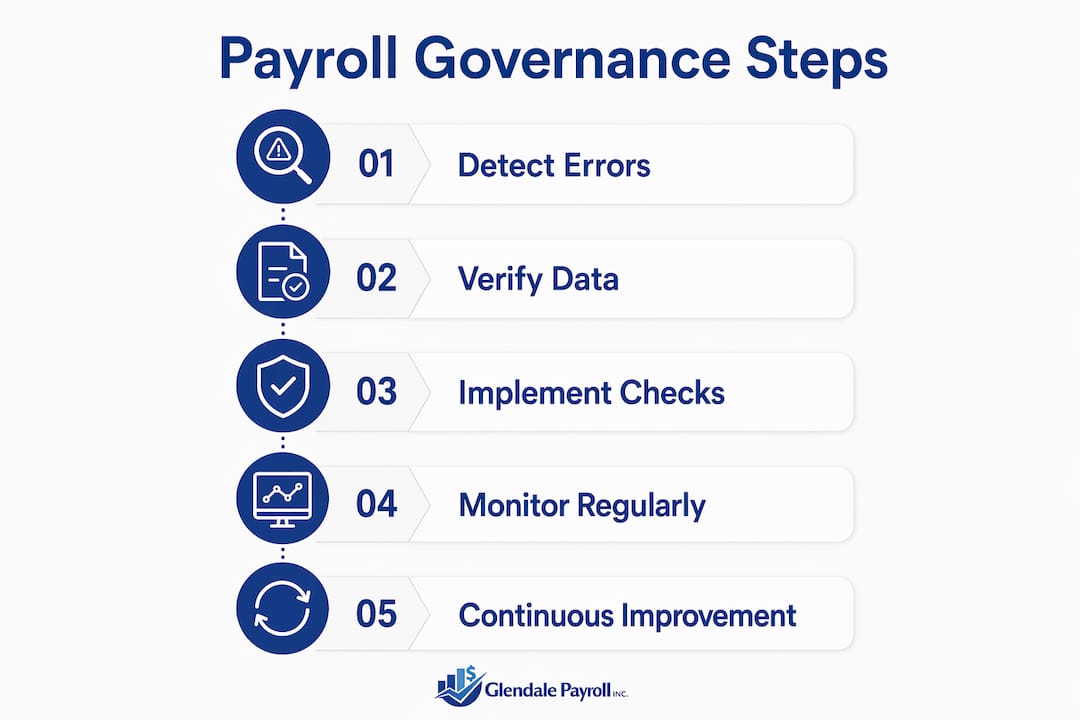
The alternative is a governance model built on prevention. Real Time Assurance models embed continuous validations directly into payroll workflows. Instead of reviewing output after processing, the system checks data at each input stage. Errors are caught before they become paychecks.
Here is how a proactive payroll governance framework works in practice:
- Define data ownership. Assign a specific person responsible for each payroll data input: HR for headcount changes, finance for salary updates, operations for hours.
- Set validation checkpoints. Build review steps into the payroll process before submission, not after. Check for missing data, outliers, and changes from the prior period.
- Conduct root cause analysis. When an error does occur, trace it back to its source. Was it a data entry issue, a system configuration problem, or a missed update? Fix the process, not just the number.
- Maintain a clear audit trail. Every change to payroll data should be logged with a timestamp and the name of the person who made it. This protects you in an audit and creates accountability.
- Review compliance updates on a schedule. Tax rates, minimum wage thresholds, and SDI rates change. Build a quarterly review into your calendar to update payroll configurations before the effective date.
| Approach | Method | Outcome |
|---|---|---|
| Reactive (detective) | Review output after processing | Errors found late, costly to correct |
| Proactive (preventive) | Validate data at each input stage | Errors caught early, low correction cost |
Payroll errors often originate from fragmented HR data and then repeat across the workforce. One misconfigured pay rate can affect every employee in a classification. End-to-end data validation stops that kind of systemic error before it multiplies.
What practical steps keep payroll accurate and compliant?
Small business owners can build reliable payroll accuracy without a large internal team. The key is putting the right processes in place before problems arise.
- Use integrated payroll software. Systems that connect HR data, time tracking, and payroll processing reduce manual entry errors. When a salary change is entered once, it flows through automatically.
- Audit your HR data inputs regularly. Attendance records, leave balances, and salary change forms are the raw material of payroll. Dirty data produces wrong paychecks. Review these inputs before every payroll run.
- Document your payroll process. A written payroll process documentation guide creates consistency when your usual processor is out sick and ensures every step is followed in the correct order.
- Track payroll deadlines on a dedicated calendar. Small business owners often underestimate banking lead times and submission deadlines. Federal holidays and weekends require adjusting payroll submission dates backward. A missed submission date can trigger IRS penalties even when the underlying calculations are correct.
- Automate where possible. Automating payroll processing reduces the manual steps where errors concentrate. Automated tax table updates, direct deposit scheduling, and filing reminders each remove a potential failure point.
- Consider outsourcing. For businesses without a dedicated payroll specialist, outsourcing to a firm with compliance expertise reduces risk and frees your time for operations. Payroll error correction costs multiple times more than prevention, and a specialist firm catches issues before they become penalties.
Pro Tip: Before each payroll run, compare the current period's total payroll to the prior period. A variance of more than 5% without a clear explanation, such as a new hire or bonus, is a signal to investigate before you process.
Key Takeaways
Payroll accuracy is the single most direct way small business owners protect employee trust, avoid IRS penalties, and maintain legal compliance across every pay period.
| Point | Details |
|---|---|
| Errors are expensive to correct | Each payroll error averages $291 to fix, and FLSA wage claims can double the original liability. |
| Personal liability is real | The Trust Fund Recovery Penalty holds owners personally liable for 100% of unpaid payroll taxes, regardless of business structure. |
| Prevention beats correction | Real Time Assurance models catch errors at the input stage, reducing cost and reputational risk. |
| Documentation is your defense | Detailed, retrievable payroll records reduce audit exposure and support legal defense. |
| Deadlines require active management | Banking lead times and federal holidays can shift submission dates, and missing them triggers IRS penalties. |
What I've learned about payroll accuracy after years of working with small businesses
Most small business owners treat payroll as a task to complete rather than a system to manage. That mindset is where the trouble starts. Payroll is not a monthly checkbox. It is an ongoing management responsibility that touches your legal exposure, your cash flow, and your relationship with every person on your team.
The risk I see underestimated most often is the Trust Fund Recovery Penalty. Owners assume their LLC or corporation shields them from personal liability. It does not. The IRS can and does pursue business owners personally for unpaid payroll taxes. I have seen this reality land hard on owners who thought their business structure was a wall between them and the IRS.
The other pattern I notice is that businesses wait for an audit or a complaint before they fix their payroll process. By then, the cost is already high. Shifting to a preventive model, where you validate data before processing rather than reviewing errors after, changes the economics entirely. The payroll best practices that actually work are not complicated. They are consistent.
Technology helps, but culture matters just as much. When your team knows that payroll accuracy is a priority at the leadership level, the data inputs improve. People submit timesheets on time. HR flags salary changes before the payroll deadline. That cultural shift is free, and it prevents more errors than any software update.
— Glendale Payroll Staff
How Glendale Payroll helps small businesses stay accurate and compliant
Small business owners in Glendale, Burbank, Pasadena, and across Greater Los Angeles face some of the most complex payroll compliance requirements in the country. California's payroll tax rules, SDI rates, and minimum wage thresholds change regularly, and staying current requires dedicated attention.

Glendale Payroll employs dedicated payroll professionals, not call center staff, to give each client expert, personalized service. The firm offers a free comprehensive payroll audit to identify risks before they become penalties. For California payroll tips tailored to small businesses, the Glendale Payroll resource library covers compliance updates, tax changes, and process best practices in plain language. If you want to know exactly where your payroll stands today, Glendale Payroll's team is ready to walk through it with you.
FAQ
What is payroll accuracy and why does it matter?
Payroll accuracy means calculating and distributing employee pay correctly and on time, every pay period. It matters because errors trigger IRS penalties, FLSA wage claims, and employee turnover, all of which cost significantly more than prevention.
How much do payroll errors typically cost a small business?
Each payroll error averages $291 to correct, and FLSA wage claims can double the original underpayment through liquidated damages. IRS late deposit penalties range from 2% to 15% of the unpaid amount.
Can a business owner be personally liable for payroll tax errors?
Yes. The Trust Fund Recovery Penalty under IRC Section 6672 holds responsible persons personally liable for 100% of unpaid payroll taxes. LLC and corporate structures do not protect owners from this penalty.
How often should small businesses review their payroll process?
A payroll accuracy review should happen before every payroll run for data inputs, and quarterly for compliance updates such as tax rate changes, minimum wage thresholds, and SDI rate adjustments.
What is the difference between reactive and proactive payroll governance?
Reactive governance finds errors after payroll is processed, which is costly to fix. Proactive governance uses Real Time Assurance models to validate data at each input stage, catching errors before they become paychecks.
Recommended
- How Payroll Automation Saves Small Businesses Time and Money | Glendale Payroll Inc.
- Payroll Process Documentation: A Guide for Small Business | Glendale Payroll Inc.
- Payroll Best Practices for Small Business | Glendale Payroll Inc.
- Benefits of Integrated Payroll Solutions for Small Businesses | Glendale Payroll Inc.