
Payroll compliance is the ongoing process by which employers accurately manage employee compensation, tax withholdings, and reporting in accordance with federal, state, and local laws. Every pay cycle creates a new set of legal obligations. Miss one, and the IRS, the Department of Labor, or a state agency will find it. For business owners and managers, understanding why payroll compliance is critical is not a theoretical exercise. It is a direct line to protecting your business from penalties, audits, and the kind of financial damage that compounds fast.
Why payroll compliance is critical: the core obligations
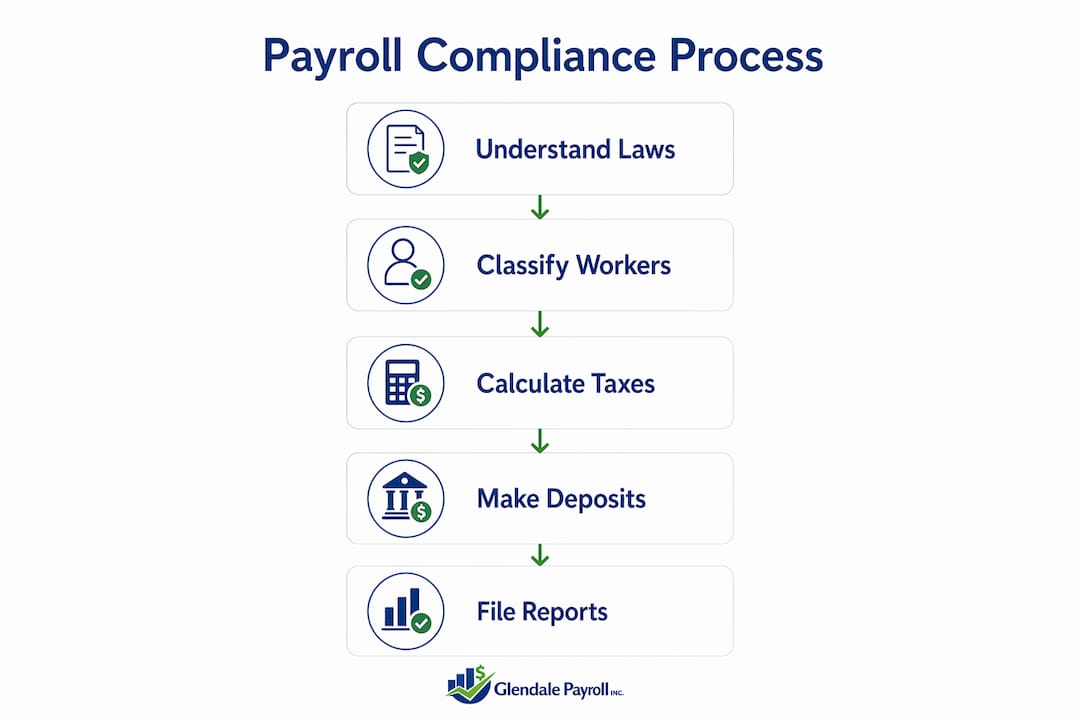
Payroll compliance is a recurring, structured obligation tied to every pay period, every quarter, and every year-end close. Employers must withhold federal income tax, Social Security, and Medicare taxes from each paycheck. They must deposit those funds on a schedule set by the IRS, file Form 941 quarterly, and reconcile everything on Form 940 annually. Each step is a checkpoint where errors can trigger penalties.
The scope extends beyond federal requirements. California employers, for example, must also manage State Disability Insurance (SDI), Unemployment Insurance (UI) contributions, and the Employment Development Department (EDD) reporting cycle. A payroll compliance framework for a Los Angeles business looks very different from one in a state with no income tax. That complexity is exactly why the role of payroll compliance in LA businesses demands dedicated attention, not a generic national template.

What are the common payroll compliance risks businesses face?
Payroll risk is not limited to one mistake. It comes from several directions at once.
- Worker misclassification. Treating an employee as an independent contractor is one of the highest-risk compliance failures a business can make. When the IRS or Department of Labor reclassifies a worker, you owe back wages, unpaid payroll taxes, and benefits retroactively. California's ABC test makes misclassification even harder to defend.
- Multi-state wage and hour errors. Remote work has pushed many businesses into multi-state payroll without the systems to handle it. Each state sets its own minimum wage thresholds, overtime rules, and withholding requirements.
- Late or missed tax deposits. The IRS applies escalating failure-to-deposit penalties starting at 2% for deposits 1–5 days late, rising to 5% for 6–15 days late, 10% for more than 15 days late, and up to 15% if the deposit remains unpaid 10 days after an IRS notice. That progression can turn a small oversight into a serious liability.
- Year-end reporting errors. Mismatches between W-2 totals and quarterly Form 941 filings trigger IRS notices and require costly corrections.
The Department of Labor's Wage and Hour Division recovered over $259 million in back wages for nearly 177,000 workers in U.S. fiscal year 2025. That figure represents the direct cost of wage-and-hour compliance failures across American businesses. The average recovery per worker was about $1,465, which means even small errors across a modest workforce add up quickly.
Pro Tip: Review your worker classification against California's ABC test at least once a year. You can find a detailed breakdown of the rules at Glendale Payroll's employee classification guide.
How does payroll compliance affect business operations and stability?
Payroll errors do not stay contained to the payroll department. They spread.
Errors cascade into audits, fines, and operational disruptions, including delays to major business events like IPOs, mergers, and acquisitions. A buyer conducting due diligence will find payroll liabilities. Those liabilities reduce your company's value or kill the deal entirely. That is a consequence most business owners never connect to a missed deposit or a misclassified contractor.
"Payroll is best viewed as a compliance-and-governance process with recurring obligations and an audit trail, not just a simple payment workflow." — IRIS, The US Employer's Payroll Compliance Handbook (2026)
Maintaining payroll compliance also requires cross-functional coordination. HR manages employee data and classification. Finance handles tax deposits and reconciliation. Benefits administrators affect pre-tax deduction sequencing. When these teams operate in silos, errors multiply. A change in an employee's benefits election, for example, can alter taxable wages and break the reconciliation between Form 941 and your payroll register.
Audit readiness is the practical standard to aim for. Your payroll records should be documented, timestamped, and defensible at any point in the year. If the EDD or IRS requests records, you need to produce them quickly and accurately. Businesses that treat audit preparation as a year-round discipline, not a reactive scramble, consistently fare better in examinations.
What are the best practices employers should implement for payroll compliance?
A payroll best practices guide starts with one principle: build systems that prevent errors before they occur, not processes that catch them after the fact.
-
Use jurisdiction-aware payroll software. Your payroll system must apply the correct withholding rates, wage thresholds, and deposit schedules for every state where you have employees. Properly configured software reduces errors and preserves consistent compliance records across every pay run. Misconfigured multi-state withholding or incorrect pre-tax deduction sequencing creates systemic errors that repeat until you fix the root cause.
-
Maintain accurate employee data. Classification, pay rate, work location, and benefit elections must be current at all times. A single stale record can generate incorrect withholdings for an entire quarter.
-
Implement deposit reconciliation controls. Reconcile your payroll tax deposits against Form 941 every quarter, not just at year-end. This is the step most businesses skip, and it is where penalty triggers hide. Filing your return on time does not protect you if your deposits were late, short, or coded incorrectly.
-
Validate year-end files before submission. The Social Security Administration's AccuWage Online tool tests electronic W-2 and W-2C files before you submit them. It catches format errors that would otherwise result in rejected filings and administrative delays. It is free, and there is no reason not to use it.
-
Create an audit log for every payroll change. Every adjustment to pay, classification, or deductions should be logged with a timestamp and a reason. This documentation is your defense in any audit.
Pro Tip: Review your California payroll tips checklist before each quarter closes. Catching a deposit timing error in week 12 costs far less than correcting it after the IRS sends a notice.
How can businesses prevent costly payroll tax deposit penalties?
Filing your payroll tax return on time is not enough. The IRS penalizes deposit failures independently of filing deadlines. You can file Form 941 on time and still owe significant penalties if your deposits were late or short.
| Deposit timing | IRS penalty rate |
|---|---|
| 1–5 days late | 2% of the unpaid deposit |
| 6–15 days late | 5% of the unpaid deposit |
| More than 15 days late | 10% of the unpaid deposit |
| 10+ days after IRS notice | Up to 15% of the unpaid deposit |
The penalty structure is designed to escalate quickly. A deposit that is three weeks late costs 10% before interest. If you ignore an IRS notice, that rate climbs to 15%. For a business with a $50,000 quarterly payroll tax obligation, a single missed deposit cycle can generate $5,000 to $7,500 in penalties before the IRS even sends a formal notice.
Multi-state businesses face additional complexity. Each state has its own deposit schedule and payment portal. A payment made to the wrong state account, or coded to the wrong tax type, counts as a missed deposit for the correct account. Tracking deposits by jurisdiction, tax type, and due date in a centralized log is the only reliable way to stay current.
Pro Tip: Set calendar reminders for every federal and state deposit due date at the start of each quarter. Automated payroll systems can trigger these deposits directly, removing the manual step entirely.
Key Takeaways
Payroll compliance protects your business from IRS penalties, Department of Labor enforcement, and operational disruptions that compound as your workforce and locations grow.
| Point | Details |
|---|---|
| Compliance is recurring | Every pay cycle, quarter, and year-end creates new legal obligations under the IRS and Department of Labor. |
| Misclassification is high-risk | Reclassifying a worker triggers back wages, unpaid taxes, and benefits liabilities that can span multiple years. |
| Deposit timing drives penalties | IRS failure-to-deposit penalties start at 2% and reach 15%, independent of whether you filed your return on time. |
| Systems prevent systemic errors | Jurisdiction-aware payroll software and quarterly reconciliation stop errors before they repeat across pay runs. |
| Audit readiness is year-round | Documented, timestamped payroll records are your defense in any IRS, EDD, or Department of Labor examination. |
What growing businesses get wrong about payroll compliance
After working with businesses across Glendale, Burbank, Pasadena, and the broader Los Angeles area, the pattern I see most often is this: business owners treat payroll as an administrative task rather than a governance function. That framing is expensive.
The moment a business adds a second location, hires a remote employee in another state, or crosses a headcount threshold that changes its IRS deposit schedule, the compliance picture changes entirely. Compliance failures snowball as companies grow. What was manageable at 10 employees becomes a systemic liability at 50.
The businesses that avoid enforcement actions are the ones where a manager owns the compliance calendar. They know their deposit due dates. They reconcile quarterly. They do not wait for a notice to find out something went wrong. Leaders must reframe payroll from a back-office function to a strategic area requiring ownership, staffing, and the right tools.
The other thing I have seen consistently: businesses that invest in proactive compliance spend far less over time than those that react to enforcement. A payroll audit today costs a fraction of what an IRS penalty notice costs six months from now. Treat compliance as an investment in operational stability, not a cost center.
— Glendale Payroll Staff
How Glendale Payroll supports your compliance goals
Payroll compliance requires more than software. It requires professionals who understand California's specific rules and stay current as those rules change.
Glendale Payroll serves businesses across Glendale, Burbank, Pasadena, and Greater Los Angeles with dedicated payroll professionals, not call center staff. Every client receives a free comprehensive payroll audit to identify existing risks before they become penalties. Whether you need help with deposit scheduling, multi-state withholding, or year-end W-2 validation, Glendale Payroll's payroll compliance services are built for the complexity California businesses face. If you are weighing whether to manage payroll in-house or hand it off, the case for outsourcing is worth reviewing before your next pay cycle.
FAQ
What is payroll compliance?
Payroll compliance is the process of accurately withholding, depositing, and reporting payroll taxes in accordance with IRS, Department of Labor, and state agency requirements. It covers every pay cycle, quarterly Form 941 filings, and annual Form 940 reconciliation.
What are the IRS penalties for late payroll tax deposits?
The IRS charges 2% for deposits 1–5 days late, 5% for 6–15 days late, 10% for more than 15 days late, and up to 15% if the deposit remains unpaid 10 days after an IRS notice.
Why does worker misclassification create payroll compliance risk?
Misclassifying an employee as an independent contractor triggers retroactive liabilities for back wages, unpaid payroll taxes, and benefits. California's ABC test makes it especially difficult to defend contractor status.
What is a payroll compliance checklist?
A payroll compliance checklist is a structured list of recurring tasks covering deposit deadlines, tax withholding accuracy, worker classification reviews, quarterly Form 941 reconciliation, and year-end W-2 validation. It functions as an operational control to prevent missed obligations.
How does payroll compliance affect businesses in Los Angeles specifically?
Los Angeles businesses must comply with federal IRS rules, California EDD requirements including SDI and UI contributions, and local wage ordinances. The layered requirements make a California-specific payroll compliance framework more complex than in most other states.