
Payroll standardization is defined as the process of creating consistent payroll procedures, data structures, and approval workflows to reduce errors, ensure compliance, and improve operational efficiency. For small to mid-sized business owners, this is not an administrative preference. It is a core business requirement. As of 2026, 93% of payroll leaders view payroll processing as a strategic growth enabler that requires standardized frameworks. New IRS reporting requirements, California pay transparency laws, and rising audit frequency make the question of why standardize payroll procedures more urgent than ever.
What are the key benefits of standardizing payroll procedures?
Payroll standardization delivers four measurable advantages: reduced compliance risk, fewer processing errors, better data quality, and stronger employee trust. Each one compounds over time. A business that standardizes early builds a foundation that scales without requiring a process rebuild every time headcount grows.
Compliance risk drops when every payroll run follows the same documented steps. New pay transparency laws require unified, standardized payroll data to produce equal-pay documentation on demand. Without that data structure in place, a pay equity audit becomes nearly impossible to pass. California employers in Glendale, Burbank, and Pasadena face some of the strictest state-level requirements in the country, making this point especially relevant.
Payroll errors fall into predictable categories: worker misclassification, overtime calculation mistakes, and missed submission deadlines. Standardization prevents these errors by replacing improvised, person-dependent workflows with documented, repeatable processes. The result is a payroll function that does not break when a key employee is out sick or leaves the company.
Data quality improves when all payroll inputs follow the same format and timeline. Finance leaders prioritize payroll standardization specifically because it gives them immediate visibility into labor costs and faster, more reliable reporting. When payroll data is inconsistent across departments or locations, executive reports slow down and lose credibility.
Key benefits at a glance:
- Compliance readiness: Consistent data structures satisfy IRS reporting and state pay equity audit requirements.
- Error reduction: Documented workflows eliminate the guesswork that causes misclassification and overtime errors.
- Faster reporting: Uniform data formats allow finance teams to pull labor cost reports without manual reconciliation.
- Employee trust: Accurate, on-time pay builds confidence in leadership and reduces HR complaints.
- Scalability: A standardized process handles 10 employees or 100 without requiring a redesign.
How does payroll standardization improve compliance and reduce risk?
Standardization supports compliance by creating a predictable, auditable payroll process. When every run follows the same data structure and approval sequence, your business can demonstrate regulatory adherence quickly and without scrambling for records.
The compliance benefit works in three specific ways:
- Audit readiness: Documented workflows and approval logs give auditors a clear paper trail. Payroll internal controls that combine role-based access, multi-factor authentication, and audit logs create accountability and prevent fraud. Without these controls, a single audit request can consume weeks of staff time.
- Regulatory responsiveness: Tax codes change. California's Employment Development Department updates SDI rates, UI Tax Rate Schedule brackets, and minimum wage thresholds regularly. A standardized system with real-time update capability transforms compliance from a reactive burden into a managed, proactive function.
- Local flexibility within a standard framework: Standardization does not mean identical processes everywhere. A two-tier model separates global data and workflow controls from local statutory execution. This prevents the common failure of forcing California-specific rules into a generic national template that does not account for state SDI, PTO payout requirements, or the ABC test for worker classification.
Pro Tip: Build your payroll calendar around regulatory deadlines first, then work backward to set internal submission cutoffs. This gives your team buffer time before the actual IRS or EDD due date.
Standardization also protects you from the risk of key-person dependency. When one employee manages payroll from memory, their departure creates a compliance gap. A documented, standard process transfers institutional knowledge to the system itself.
What practical steps can SMBs take to standardize payroll?
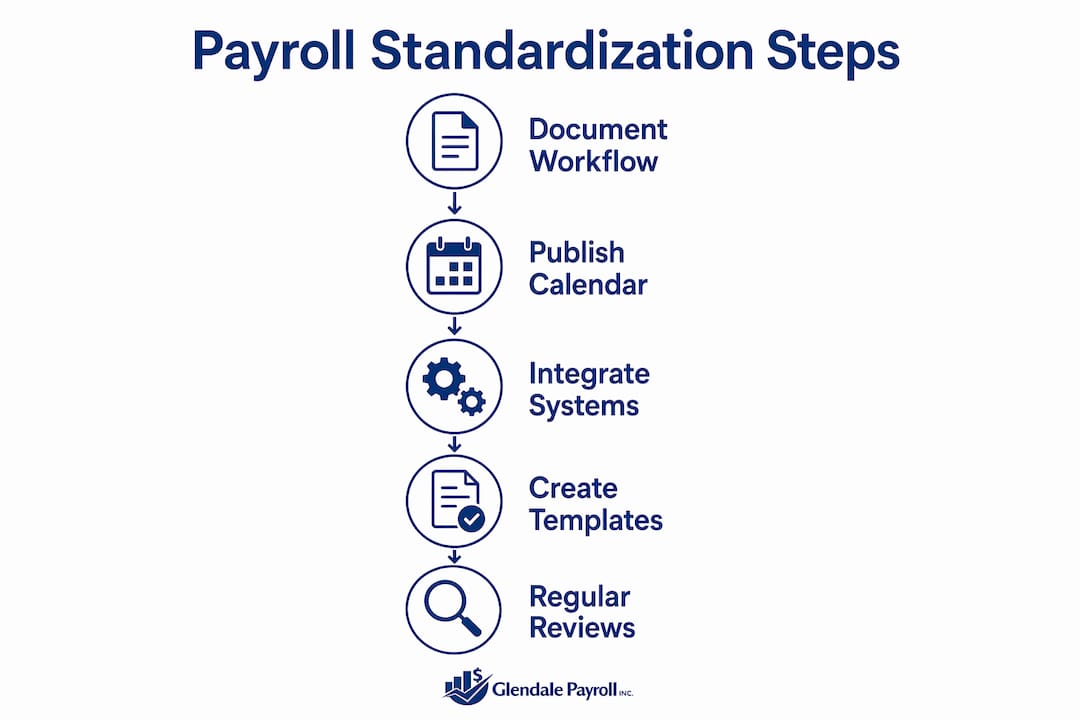
Standardizing payroll is a project, not a single decision. The following steps give you a clear path from improvised processes to a repeatable, compliant system.
Document every workflow end to end. Write down each step in your payroll process, from time data collection through final direct deposit. Assign a named owner and a deadline to each step. Payroll process documentation is the foundation of every other improvement. Without it, you cannot identify gaps or train replacements.

Publish a firm payroll calendar. Strict, non-negotiable payroll calendars for cutoff dates enforce discipline in manager approvals and time inputs. This eliminates errors caused by last-minute changes. Post the calendar where every manager can see it, and treat submission deadlines the same way you treat tax filing deadlines. No exceptions.
Integrate your payroll and HR systems. Compatible systems that share data automatically reduce manual entry and the errors that come with it. Payroll software integration with your HR platform means employee status changes, new hires, and terminations flow directly into payroll without a separate data entry step.
Create templates for non-routine transactions. Bonuses, commissions, garnishments, and retroactive pay adjustments are where errors concentrate. Well-designed templates for these transactions preserve institutional knowledge and prevent costly process breakdowns. A template also makes it easier to train a new payroll administrator quickly.
Separate global standards from local execution. If your business operates across multiple California jurisdictions or states, standardize what data you collect and when. Leave the tax calculation logic to jurisdiction-specific rules or a local payroll expert. Standardization works best when it controls the "what" and "when" while allowing flexibility in the "how."
Pro Tip: Run a payroll process review every six months. Regulations change, your workforce changes, and your documented process needs to keep pace. Glendale Payroll offers a free payroll audit that identifies exactly where your current process creates risk.
What are common challenges in payroll standardization?
Most SMBs hit the same roadblocks when they try to standardize payroll. Knowing them in advance lets you plan around them rather than react to them.
Improvisational payroll is the most common problem. It happens when payroll runs differently each cycle depending on who is handling it. The fix is documentation and a single source of truth for process steps. Once the workflow is written down and assigned, improvisation has nowhere to hide.
Over-automation without local knowledge creates a different kind of failure. Businesses that automate payroll without accounting for California-specific rules like SDI contributions, PTO cash-out requirements, or the ABC test for contractor classification end up with compliant-looking output that is actually wrong. Automation speeds up a process. It does not fix a flawed one.
Communication and accountability gaps appear when managers do not treat payroll deadlines seriously. The solution is role-based access controls and documented approval workflows. Strong payroll internal controls prevent fraud and inconsistency by creating clear accountability at every step.
| Challenge | Root cause | Solution |
|---|---|---|
| Inconsistent payroll runs | No documented workflow | Write and assign each process step |
| Automation errors | Generic templates ignore local rules | Apply local statutory logic separately |
| Missed deadlines | No enforced payroll calendar | Publish non-negotiable cutoff dates |
| Audit failures | No approval logs or access controls | Implement role-based access and audit trails |
| Knowledge loss on staff turnover | Process lives in one person's head | Document workflows and use templates |
Exception handling is where even well-run payroll operations stumble. A mid-cycle termination, a retroactive bonus, or a garnishment order all require a defined response. Build exception templates into your standard process so these situations follow a predictable path rather than creating a one-off scramble.
Key Takeaways
Standardizing payroll procedures is the single most effective step an SMB can take to reduce compliance risk, improve data accuracy, and build a payroll function that scales.
| Point | Details |
|---|---|
| Compliance depends on consistency | Uniform data structures satisfy IRS, EDD, and pay transparency audit requirements. |
| Payroll calendars eliminate errors | Non-negotiable cutoff deadlines remove last-minute changes that cause processing mistakes. |
| Documentation transfers knowledge | Written workflows prevent process breakdowns when key staff leave or change roles. |
| Local rules need local logic | Standardize data and approvals globally, but apply jurisdiction-specific tax rules separately. |
| Internal controls prevent fraud | Role-based access, approval workflows, and audit logs create accountability at every step. |
What I have learned from working with SMBs on payroll standardization
After working with businesses across Glendale, Burbank, and Pasadena, one pattern stands out clearly. The owners who treat payroll as critical infrastructure, not a back-office chore, are the ones who avoid IRS penalties and pass audits without panic.
The most common mistake I see is waiting until something goes wrong. A misclassified worker, a missed EDD deadline, or a failed pay equity audit is always more expensive than the cost of building a proper process upfront. Standardization is not a one-time project. It is an ongoing discipline that pays for itself every quarter.
The insight that surprises most business owners is this: you do not need identical processes everywhere to achieve standardization. What you need is a common operating model. Standardize what data you collect, when you collect it, and who approves it. Then let local expertise handle the tax calculation layer. That balance is what separates payroll operations that scale from ones that break under pressure.
Payroll standardization also builds employee trust in a way that is easy to underestimate. When employees are paid accurately and on time, every time, they stop worrying about payroll. That reduction in HR noise is real and measurable. It frees your team to focus on work that actually grows the business.
— Glendale Payroll Staff
How Glendale Payroll supports your standardization goals
Glendale Payroll works with small to mid-sized businesses across Greater Los Angeles to build payroll processes that are consistent, compliant, and audit-ready.
Every client engagement starts with a free comprehensive payroll audit that identifies exactly where your current process creates compliance risk or processing errors. From there, Glendale Payroll's dedicated payroll professionals, not call center staff, build a standardized workflow tailored to your business size and California-specific requirements. For practical guidance you can use right now, the California payroll tips resource covers accuracy, compliance, and process improvement for SMBs. You can also review the full California compliance guide for jurisdiction-specific requirements that affect businesses in Glendale, Burbank, and Pasadena.
FAQ
What is payroll standardization?
Payroll standardization is the process of creating consistent payroll procedures, data structures, and approval workflows across your organization. It reduces errors, supports compliance, and makes payroll data reliable for reporting and audits.
Why standardize payroll procedures if your business is small?
Small businesses are not exempt from IRS penalties, EDD audits, or California pay transparency requirements. Standardized procedures protect a 10-person business just as effectively as a 500-person one, and they are far easier to build before the business grows than after.
How does a payroll calendar reduce errors?
A published, non-negotiable payroll calendar sets firm deadlines for time submissions and manager approvals. This eliminates the last-minute changes that cause calculation errors and missed tax deposits.
What is the difference between payroll standardization and payroll automation?
Standardization defines the rules, workflows, and data structures your payroll process follows. Automation executes those steps faster. Automation without standardization speeds up a flawed process. Standardization first, then automation, is the correct sequence.
How often should you review your payroll process?
A payroll process review should happen at least twice per year. California tax rates, minimum wage thresholds, and SDI contribution rates change regularly, and your documented process must reflect current requirements to remain compliant.