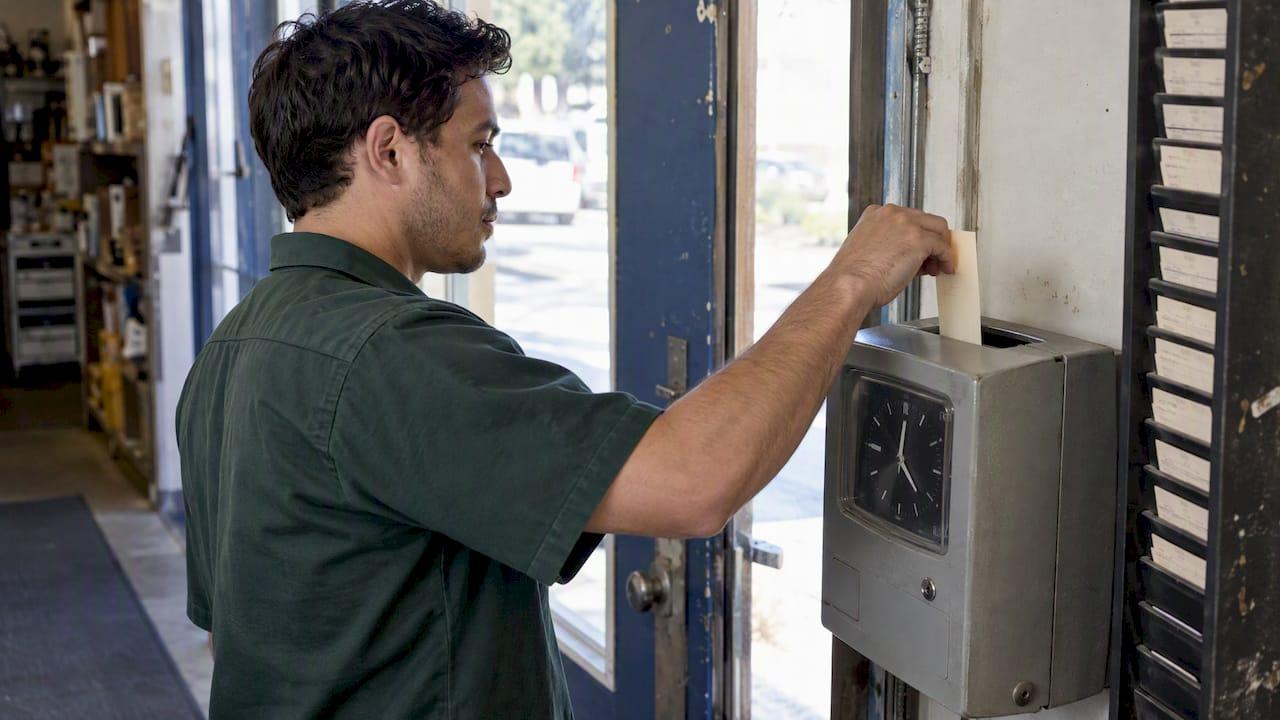
If you employ nonexempt workers in California, you must keep accurate daily records of when each person starts and stops work, when meal periods begin and end, and total hours worked each day. You must keep them in English, in a permanent format, for at least three years. California does not dictate whether you use a time clock, an app or paper. It does dictate what the record must show and what happens when it is wrong.
This guide covers what to record, how long to keep it, why rounding and the "7-minute rule" are risky, and how timekeeping connects to your wage statements and your penalty exposure.
TL;DR
- Record daily start and stop times, meal period times and total daily hours for every nonexempt employee, and keep those records at least three years.
- You choose the method (paper, time clock or software), but the record must be accurate, in English and tamper-resistant.
- You must pay for all time worked that you knew or should have known about, even if it was not authorized.
- Rounding punches is risky in California, and meal period punches should never be rounded.
- Your time records feed the itemized wage statement. Errors there are easy to document and expensive to defend.
Table of Contents
- What California requires you to record
- Do you need a time clock?
- Pay for all time worked, authorized or not
- Daily and weekly overtime depend on accurate records
- Meal periods: record them, and never round them
- Rounding and the "7-minute rule"
- Is there a grace period for clocking in?
- How long to keep the records
- Your wage statement must match your time records
- Final pay and waiting time penalties
- Our perspective
- A 30-minute timekeeping review you can do this week
- How Glendale Payroll helps
- FAQ
- Sources
What California requires you to record
The core rule sits in Labor Code Section 226 and the Industrial Welfare Commission (IWC) wage orders. Together they require accurate daily time records for nonexempt employees, including the exact time each work period begins and ends, meal periods and total daily hours. The records must be in English, kept in an indelible format, and preserved for at least three years at the worksite or a central location in California.
The wage orders spell out the rest. Wage Order 4, 5 and the others differ by industry, and the order for professional, technical, clerical and mechanical occupations (Order 11040) opens its records section by requiring accurate information on each employee: full name, home address, occupation and Social Security number, plus time records. Find the wage order that covers your industry and read its Records section. That is the version that applies to you.
A practical checklist
For each nonexempt employee, your system should capture:
- Start and end of each work period, to the minute.
- Meal period start and end, recorded by the employee or captured by the system.
- Total hours worked each day and each workweek.
- Every applicable hourly rate and the hours worked at each.
- Overtime and double-time hours, separated from regular hours.
- Employee identity details required by your wage order.
The records must be retrievable. If an employee or the Labor Commissioner asks, you need to produce them, and a record you cannot find is a record you cannot use in your defense.
Exempt employees
The daily time-record requirement is aimed at nonexempt workers. Exempt status in California is narrow, because the employee must meet both a duties test and a salary test. If you classify someone as exempt and later lose that argument, you will have no time records for the hours they worked, and the burden shifts against you. Review each classification before you decide not to track someone's time.
Do you need a time clock?
No. California does not require any particular technology. Paper time cards, a spreadsheet signed by the employee, a punch clock, a phone app or a cloud-based system all work if the records are accurate and complete. What matters is that the record reflects actual time worked, not scheduled time.
Scheduled-time records are a common weakness. If your system auto-fills 8:00 to 5:00 with a 30-minute lunch and employees rarely deviate on paper, a claimant will argue that the record proves nothing. Employers who track actual punches, with a process for employees to flag corrections, are in a much stronger position.
If you manage hourly staff in an unusual setting, such as instructors paid by the class, it helps to see how others structure it. This walkthrough on setting up staff time tracking with the required details and retention shows the kinds of fields a time record should capture, even though your industry may differ.
Pay for all time worked, authorized or not
The standard for compensable time in California is "suffered or permitted to work." Under the Division of Labor Standards Enforcement (DLSE) overtime guidance, if you knew or should have known that an employee was working, you must pay for that time.
Many owners assume a written policy banning unauthorized overtime protects them. It does not. You can discipline an employee who breaks the policy, but you cannot withhold pay for time actually worked. Your timekeeping system should therefore capture all work, including early log-ins, answering messages after hours and closing duties, and your managers should know that they cannot look away from it.
Daily and weekly overtime depend on accurate records
California overtime is calculated daily, not just weekly. According to the DLSE overtime page:
- 1.5 times the regular rate for hours over eight in a workday, over 40 in a workweek, and for the first eight hours on the seventh consecutive day of work.
- 2 times the regular rate for hours over 12 in a workday, and for hours over eight on the seventh consecutive day.
A weekly-only record cannot support those calculations. You need daily totals. The workday and workweek definitions in the Labor Code also matter: a workday is any consecutive 24-hour period commencing at the same time each calendar day, so you should fix the start of your workday and workweek in writing and apply it consistently in payroll.
For a deeper look at the calculations, see our guide to California overtime rules for employers.
Alternative workweek schedules
A 4/10 schedule is not something you can adopt by agreement. An Alternative Workweek Schedule requires a formal secret-ballot election in the affected work unit, a required percentage of affirmative votes and, in some cases, reporting to the state. Without that process, you owe daily overtime after eight hours. If you have a valid election, keep the records of it permanently. They are your primary defense in a wage-and-hour audit.
Meal periods: record them, and never round them
Under Labor Code Section 512, you cannot employ someone for more than five hours in a day without a meal period of at least 30 minutes, and a second meal period applies when the workday exceeds 10 hours. If a required meal period is not provided, you owe the employee one additional hour of pay at the regular rate for each workday the violation occurs.
That premium is why meal punches matter. A clean record of a 30-minute meal, started before the end of the fifth hour, is your evidence that you complied. A missing or auto-deducted entry leaves you without proof. Employees who are interrupted, or who clock out late for lunch, create premium-pay exposure that shows up only if your system captures the real times.
The California Supreme Court held in Donohue v. AMN Services that meal period punches cannot be rounded, as summarized by a national employment law publication. If your software rounds all punches to the nearest quarter hour, check whether meal punches are included.
The pay consequences can reach back years. Our article on meal break penalties and back pay explains how the exposure builds.

Rounding and the "7-minute rule"
A frequent question is whether you can round punches to the nearest quarter hour. The "7-minute rule" comes from federal enforcement guidance. The U.S. Department of Labor Field Operations Handbook addresses rounding for federal purposes, and California is a different matter.
California courts have grown skeptical. In Camp v. Home Depot, the Court of Appeal indicated that where a system can capture, and has captured, time to the minute, rounding that leaves an employee underpaid is hard to defend, according to the same legal summary. That does not mean every rounding policy is unlawful, but it means the safe approach today is to pay on actual recorded minutes.
Our practical advice:
- Configure your time system to pay to the minute.
- If you currently round, ask your payroll provider or employment counsel to test your data for a pattern of underpayment.
- Never treat the federal rule as a safe harbor in California.
Is there a grace period for clocking in?
Not as a legal safe harbor. If an employee is working, the time is compensable. If you require employees to be at their station, in uniform or logged in at a given time, the clock should start when that work does. Setting a rule that punches within a few minutes of shift start are ignored invites the same exposure as rounding. Decide when work begins, then record from that moment.
How long to keep the records
The minimum is three years under Labor Code Section 226 and the wage orders, kept at the worksite or a central location in California. Our recommendation is to keep them longer when you have any doubt about a dispute, and to keep alternative workweek election records permanently.
Store records so they can be produced on request. If you use software, confirm you can export complete punch-level data, not just summary hours, and that you retain access if you change vendors.
Your wage statement must match your time records
Timekeeping ends in the paycheck. The DLSE recordkeeping guidance says every employer must give each employee an itemized statement, semimonthly or at each payment of wages, with nine specific items. Section 226 includes gross wages, total hours worked, deductions, net wages, pay period dates, employer and employee information, and all applicable hourly rates.
These mistakes are easy to document, which is why they often show up in class actions. A wage statement that shows 80 hours when the time records show 82 is a visible inconsistency. Tie your time system to payroll so one source feeds the other.

Pay timing matters too. See our guide to California pay frequency rules.
Final pay and waiting time penalties
Bad records become most expensive at separation. The DLSE final pay guidance states that discharged employees must be paid all wages due at termination, including earned but unused vacation pay. Employees who quit with at least 72 hours of notice must be paid at the time of quitting. Without notice, you have 72 hours.
If you miscalculate because your time records were incomplete, you may owe waiting time penalties at the employee's daily rate for up to 30 days. A good-faith dispute does not excuse you from paying the undisputed portion on time. Read more in our articles on final paycheck rules and waiting time penalties.
Our perspective
In our work with small businesses in Glendale, Burbank, Pasadena and the wider Los Angeles area, we see the same pattern. Owners rarely ignore timekeeping. They build it on assumptions: that a lunch is always taken, that a rounding rule is safe, that a policy against overtime protects them. The gap between the assumption and the record is where penalties come from.
We believe the fix is simple, if not always easy. Record actual time. Pay on it. Make sure the wage statement matches. Review it regularly rather than after a claim. That is why our payroll work is handled by dedicated payroll professionals instead of a call center, and why we begin with a free payroll audit that looks for exactly these gaps between time records, pay and filings.
— Glendale Payroll Staff
A 30-minute timekeeping review you can do this week
- Pull one pay period of punch data for five nonexempt employees.
- Check that every day has a start, end and meal period entry.
- Compare punch totals with the hours on the wage statement.
- Look for identical punch times day after day, which suggest scheduled rather than actual time.
- Confirm that overtime and double time were calculated daily.
- Confirm the retention location and period for your records.
- List any rounding or auto-deduct settings in your software and decide whether to keep them.
How Glendale Payroll helps
If you would rather not carry this alone, we process payroll, file federal and California payroll taxes, handle direct deposit, W-2s, new hire reporting and EDD account setup, and begin with a free comprehensive payroll audit. Our published pricing is $105 per month per company plus $12 per month per employee, with a one-time setup fee of $100. For a team of 10 employees, that is $225 per month plus the $100 setup. See the details on our pricing page or our services page.
FAQ
Does California require a time clock?
No. You may use paper, a punch clock or software. The records must be accurate, in English and kept in a permanent format for at least three years, showing when each work period begins and ends.
Can I round employee time in California?
It is risky. Meal period punches cannot be rounded, and courts have questioned rounding where exact time is captured. The safest practice is to pay on actual recorded minutes and have your data tested before relying on any rounding policy.
What is the 4/10 rule in California?
It refers to an Alternative Workweek Schedule of four 10-hour days. It is valid only after a secret-ballot election of the affected work unit and the other required steps. Without a valid election, hours over eight in a day are overtime.
What is the 72-hour rule in California?
It applies to final pay when an employee quits. With at least 72 hours of notice, you pay all wages at the time of quitting. Without notice, you have 72 hours from when they quit.
Sources
- California Labor Code Section 226
- California Code of Regulations, Title 8, Section 11040
- DLSE: Overtime
- California Labor Code, Division 2, Part 2 definitions
- California Labor Code Section 512
- National Law Review: California Court of Appeal and rounding
- U.S. DOL Field Operations Handbook, Chapter 30
- DLSE: Recordkeeping and statement of wages
- DLSE: Final pay